

The first major expansion of Global Capability Centers (GCCs) in India was driven by a simple
arithmetic goal: build bigger campuses, scale seat capacity, and execute transactional processes at
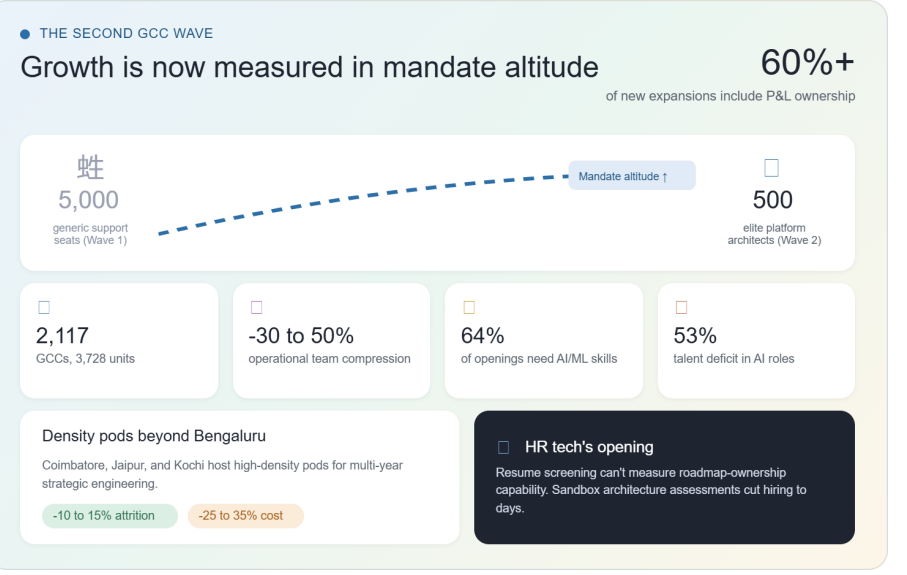
scale. However, the ecosystem has entered its “Second Wave.” Instead of measuring growth by
physical real estate expansion or pure headcount additions, global parent organizations are expanding
the strategic depth, decision-making authority, and intellectual property ownership of their existing
centers.The focus has decisively shifted from seat capacity to mandate altitude.
This shift is fundamentally redefining broader GCC trends across the country. India currently hosts
2,117 active GCCs operating across 3,728 distinct units, forming a $98.4 billion economic sector
that employs over 2.36 million skilled professionals. Crucially, as over 60% of new GCC
expansion announcements now explicitly include global product, platform, or P&L ownership
mandates, existing centers are no longer asking headquarters for more budget to hire entry-level
volume. Instead, local leaders are securing the autonomy required to architect global cloud
frameworks, manage cybersecurity resilience, and run end-to-end product roadmaps directly out of
India.

The primary technical force driving this elevation in mandate altitude is the deep integration of AI and
automation across corporate infrastructure. Autonomous agentic workflows and automated developer
platforms are compressing traditional operational team structures by 30% to 50%, while
simultaneously expanding the center’s capability scope.With 64% of all new GCC job openings
requiring advanced AI or machine learning skills against an industry-wide 53% talent deficit in
specialized AI roles, parent companies are not looking to build 5,000-person support teams. Instead,
they are deploying high-density pods of 500 elite platform architects and MLOps engineers in India
who own global enterprise platforms.
Navigating this second wave requires progressive future-of-work thinking that transforms overall
enterprise talent strategy.To support broader mandates without facing severe talent saturation in
primary tech hubs like Bengaluru and Hyderabad, global firms are deploying a multi-hub strategy.
Expanding specialized capability spokes into emerging Tier-2 tech hubs like Coimbatore, Jaipur, and
Kochi allows GCCs to secure 10% to 15% lower voluntary attrition rates while achieving 25% to
35% in overall operational cost savings.These regional hubs provide stable environments where
high-density talent pods can focus on multi-year strategic product engineering.
This elevation from task execution to strategic ownership presents an extraordinary growth vector for
HR innovation, driving rapid market adoption for agile B2B HR startups. Legacy applicant tracking
tools built to screen thousands of identical resumes fail to measure an engineer’s capability to own a
global product roadmap. High-growth HR tech startups developing AI-driven skill-graph evaluation
engines, live sandbox architecture assessments, contribution-based portfolio analytics, and real-time
leadership capability graphs are seeing rapid enterprise integration. Modern platforms empower talent
acquisition leaders to shorten specialist recruitment cycles from months down to days, bringing databacked precision to executive and high-density talent acquisition.