

For decades, corporate talent deployment was dictated by rigid organizational hierarchies, fixed job
descriptions, and departmental siloes. An engineer assigned to a legacy maintenance team stayed
within that business unit, regardless of their unutilized expertise in neural network fine-tuning or cloud
architecture. However, in an economy where technical skills evolve rapidly and enterprise speed
dictates market survival, forward-thinking Global Capability Centers (GCCs) in India are dismantling
static team structures. Enterprises are deploying internal gig marketplaces—AI-powered platforms
that allow employees to apply for short-term projects, cross-functional sprints, and innovation
initiatives inside their own company.
This internal fluidity is fundamentally transforming macro GCC trends across the nation. India currently
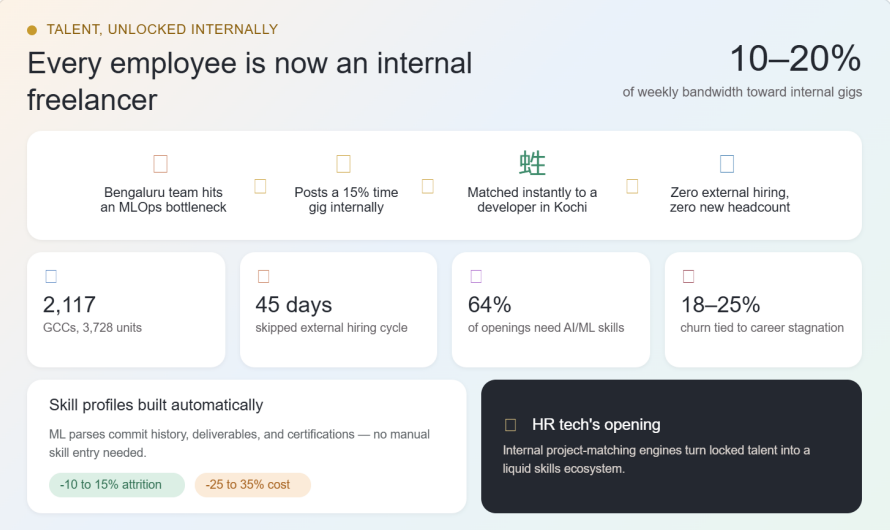
hosts 2,117 active GCCs operating across 3,728 distinct units, forming a $98.4 billion economic
sector that employs over 2.36 million skilled professionals. Crucially, because over 90% of these
hubs operate as multi-functional innovation centers owning global product roadmaps, project
demands fluctuate dynamically.When a team in Bengaluru faces an unexpected bottleneck in MLOps
pipeline security, instead of initiating a 45-day external hiring cycle or contracting expensive thirdparty agencies, project leads post a 15% time “gig” on their internal marketplace.The platform instantly
matches the task with a qualified developer in Kochi or Jaipur, unlocking hidden capability without
increasing overall headcount costs.

The technical catalyst driving this internal project mobility is the rapid integration of AI and automation
across business infrastructure. Machine learning algorithms continuously parse code commit histories,
project deliverables, and verified certifications to build dynamic employee skill profiles.With 64% of all
new GCC job openings mandating advanced AI or machine learning capabilities against a
severe 53% talent deficit in specialized AI roles, waiting for external talent supply is no longer
viable. Internal gig marketplaces create a frictionless environment where employees allocate 10% to
20% of their weekly bandwidth toward high-impact cross-functional tasks, accelerating project
delivery while gaining hands-on exposure to emerging technologies.
Decoupling work from static job titles reflects progressive future-of-work thinking that rebuilds overall
enterprise talent strategy. Giving employees the autonomy to “apply” for internal gigs directly
addresses career stagnation, a primary driver of voluntary tech churn, which lingers between 18% and
25% across major tech corridors.To scale these agile talent networks without creating operational
friction in primary hubs like Bengaluru and Hyderabad, global firms are expanding into emerging
secondary hubs like Coimbatore, Jaipur, and Kochi. Establishing regional talent spokes within an
internal gig network enables GCCs to achieve 10% to 15% lower voluntary attrition rates while
securing 25% to 35% in overall operational cost savings, creating stable environments where
employees actively drive their own career development.
This shift toward project-based internal mobility presents an extraordinary growth vector for HR
innovation, driving rapid market adoption for agile B2B HR startups. Legacy human resource
management platforms built for static reporting cannot manage dynamic task allocation, crossdepartmental time tracking, or manager approval workflows. High-growth HR tech startups developing
AI-driven internal project matching engines, contribution-based skill validation tools, automated
manager capacity-allocation protocols, and internal gig analytics are seeing rapid enterprise
integration. Modern workforce marketplaces empower HR leaders to turn locked internal talent into a
dynamic, liquid skills ecosystem.