

For decades, workforce data sat dormant in transactional HR software, treated primarily as an
administrative record for payroll processing, compliance reporting, and annual review archives.
However, as artificial intelligence restructures enterprise execution, workforce data has transformed
into a high-yield strategic asset. In 2026, the most valuable currency for Global Capability Centers
(GCCs) and global enterprises is not physical real estate or raw computing power—it is granular, realtime employee data that powers predictive talent models and operational decision-making.
This migration toward data-centric workforce management is reshaping macro GCC trends across
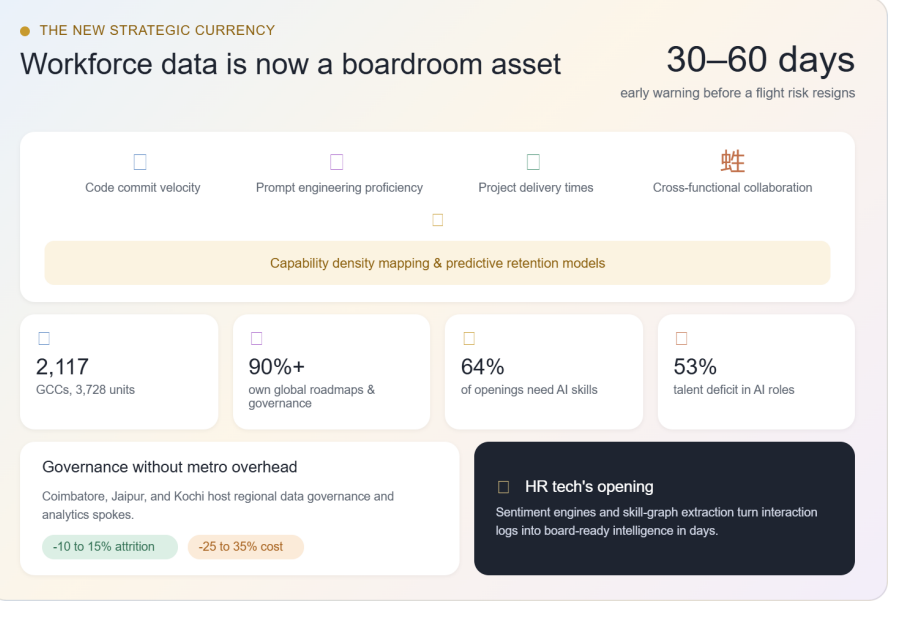
India.The nation’s capability ecosystem currently encompasses 2,117 active GCCs operating across
3,728 distinct units, representing a $98.4 billion economic sector that employs over 2.36 million
skilled professionals. Crucially, because over 90% of these hubs operate as multi-functional
innovation centers owning global product roadmaps and strategic governance, executive
boardrooms rely on local operational data to drive global strategy.Treating workforce metrics as static
reports produces severe blind spots. By structuring live employee data—tracking code commit velocity,
prompt engineering proficiency, project delivery times, and cross-functional collaboration patterns—
GCCs can accurately map organizational capability density and predict project outcomes.

The primary technical force driving the appreciation of employee data is the rapid integration of AI and
automation across business infrastructure. AI agents and machine learning platforms require
continuous, high-quality contextual data to optimize task allocation, evaluate engineering quality, and
identify workflow bottlenecks.With 64% of all new GCC job openings mandating advanced AI
capabilities against an industry-wide 53% talent deficit in specialized AI roles, enterprises use
employee data to run predictive retention models. By analyzing subtle drops in platform activity or skill
stagnation, real-time analytics engines alert managers to flight risks 30 to 60 days before a
resignation letter is submitted, allowing proactive interventions that keep voluntary tech churn below
industry averages.
Leveraging employee data as a strategic asset requires progressive future-of-work thinking to
reshape overall talent strategy. Instead of hoarding data in isolated HR siloes, forward-thinking
organizations combine workforce metrics with financial and product performance indicators.To build
secure, compliant data governance architectures without facing extreme costs in primary tech hubs like
Bengaluru and Hyderabad, global firms are deploying specialized data management pods across
regional hubs like Coimbatore, Jaipur, and Kochi. Establishing regional compliance and analytics
spokes enables GCCs to achieve 10% to 15% lower voluntary attrition rates while securing 25% to
35% in overall operational cost savings, creating stable environments for enterprise data
governance.
This monetization of workforce intelligence creates an extraordinary market opportunity for HR
innovation, accelerating enterprise adoption for agile B2B HR startups. Legacy human resource
management platforms built for static record-keeping fail to extract value from unstructured workplace
interactions. High-growth HR tech startups developing real-time workforce sentiment engines,
automated skill-graph extraction algorithms, privacy-preserving data clean rooms, and predictive
capability analytics are seeing rapid enterprise integration. Modern platforms empower talent leaders to
transform raw employee interaction logs into board-ready operational intelligence, shortening decision
cycles from months down to days.