

The era of simple Generative
AI—where users prompt a model to draft text or answer queries—is rapidly giving way to Agentic AI.
Unlike passive chatbots that wait for instructions, AI agents act as autonomous digital teammates.
They possess reasoning capabilities, break down multi-step goals, interface with complex enterprise
software, and execute end-to-end operational workflows with minimal human intervention. For
human resource departments and employees across Global Capability Centers (GCCs), this transition
from conversational assistants to goal-driven digital agents is fundamentally altering how work gets
designed, measured, and delivered.
This shift toward agentic systems directly impacts the expansion of Global Capability Center (GCC)
trends across India. The country currently hosts 2,117 active GCCs operating across 3,728 distinct
units, generating an extraordinary $98.4 billion in annual market value and employing over 2.36
million skilled professionals. As over 90% of these capability hubs evolve into multi-functional
innovation centers, enterprise boardrooms are deploying autonomous agents to handle continuous
software testing, cloud infrastructure monitoring, and real-time financial reconciliation.
Data shows that over 78% of GCCs actively deploy intelligent workflows,
with 64% of all new technical job openings explicitly mandating advanced AI or machine
learning skills. However, the market faces a 53% talent deficit in specialized AI roles, keeping
voluntary tech churn at 18% to 25%. In an agentic environment, employees are no longer evaluated
on manual coding throughput or process completion speed. Instead, human value centers on system
architecture, prompt logic design, exception handling, and governing autonomous AI agents to
ensure alignment with enterprise objectives.
Adapting to this environment demands progressive future-of-work thinking to reshape enterprise
talent strategy. GCC leaders are abandoning linear headcount models, focusing instead on
capability density and human-agent collaboration. As part of this strategic evolution, organizations
are aggressively expanding engineering footprints into emerging Tier-2 hubs like Coimbatore, Jaipur,
and Kochi. Operating in these expanding regional nodes enables enterprises to tap into stable talent
pools while benefiting from 10% to 15% lower attrition rates and securing 25% to 35% in overall
operational cost savings.
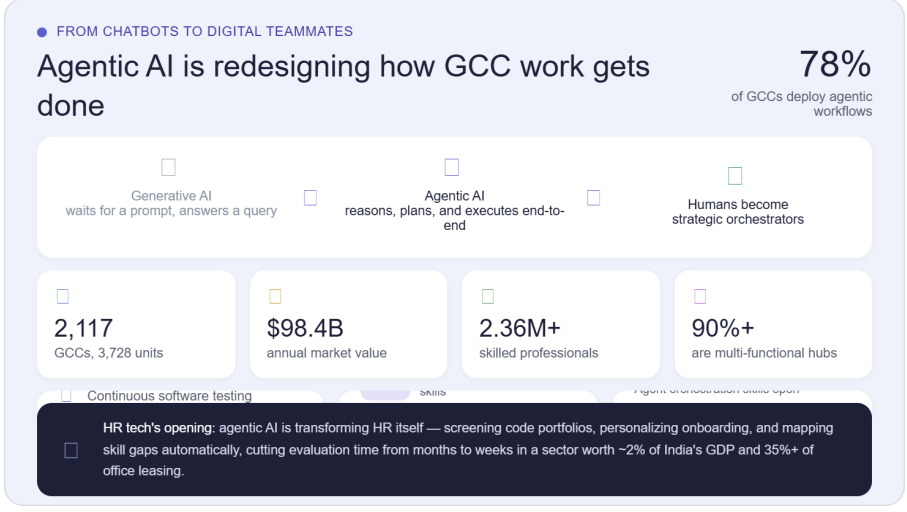
Agentic AI is transforming internal HR operations themselves,
enabling autonomous systems to handle complex multi-step tasks like screening candidate code
portfolios, personalized employee onboarding, and real-time skill-gap mapping. Modern HR tech
startups building AI-driven assessment engines, real-time compensation intelligence tools,
automated onboarding portals, and predictive retention analytics are seeing rapid enterprise
integration. These advanced platforms empower talent acquisition managers to cut candidate
evaluation timelines from months down to weeks, bringing data-backed precision to talent
discovery.