

As artificial intelligence and autonomous workflows sweep through global enterprise architectures,
anxiety surrounding potential job loss across India’s Global Capability Center (GCC) ecosystem has
reached a peak. For university graduates, HR leaders, and B2B tech platforms, the central question is
no longer whether automation will impact daily tasks, but whether it will shrink overall operational
headcount or trigger an unprecedented boom in specialized human capability. While entry-level
transactional tasks are rapidly automated, the broader reality reveals a strategic evolution: AI is not
destroying GCC careers—it is rapidly replacing low-value process execution with high-value, highly
specialized technical roles.
This structural transformation is directly reflected in the massive expansion of GCC trends across
India. Today, the country hosts 2,117 active GCCs operating across 3,728 distinct units, forming a
massive $98.4 billion economic ecosystem employing over 2.36 million professionals. Rather
than reducing workforce size, GCC hiring is projected to reach 510,452 new jobs in 2026 alone,
representing a 3.4-fold increase since 2021. However, the internal composition of these jobs has
shifted radically. With 64% of all new GCC openings explicitly requiring AI, data science, or
intelligent automation skills, routine execution roles are being phased out in favor of specialized
engineers, AI architects, model evaluators, and platform security experts.

The continuous integration of AI and automation explains why specialized demand continues to
outpace available talent supply. As enterprises deploy generative and agentic systems to handle
routine coding, documentation, and L1 support, demand for niche AI skills has surged by over 300%
year-over-year. However, India currently faces an industry-wide 53% talent deficit in specialized AI
roles, keeping voluntary tech churn high at 18% to 25%. The talent market is experiencing a doubleedged reality: generic, unspecialized applicants face extreme competition, while highly skilled
professionals capable of designing, governing, and optimizing AI systems enjoy unprecedented
market leverage and compensation premiums.
Navigating this changing landscape requires forward-thinking future-of-work thinking to reshape
enterprise talent strategy. Progressive organizations recognize that capability density matters far
more than raw employee seat count. To build stable, high-output specialist teams without entering
unsustainable bidding wars in Tier-1 metros, global firms are expanding into emerging secondary
hubs like Coimbatore, Jaipur, and Kochi. Establishing operations in these regional centers allows
enterprises to achieve 10% to 15% lower attrition rates and secure 25% to 35% in overall
operational cost savings, building stable environments where specialized engineering talent can
thrive.
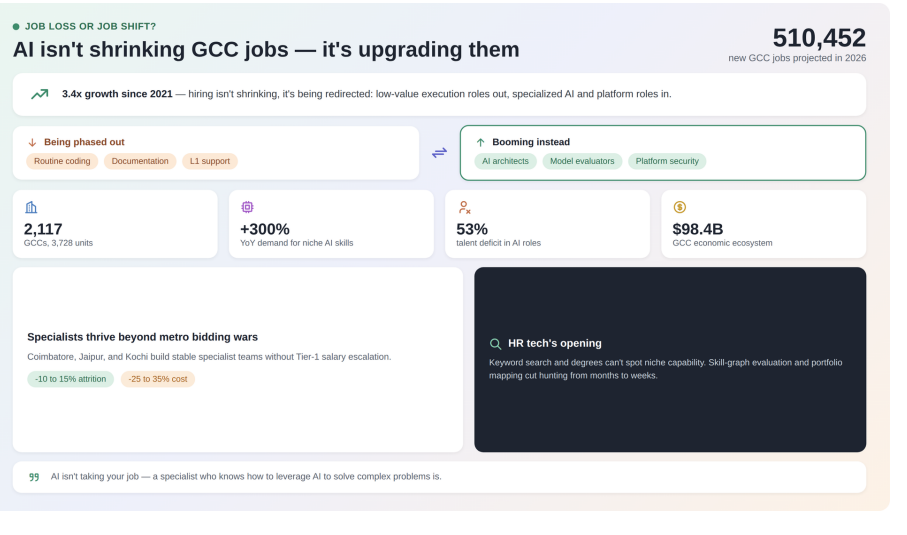
This shift toward hyper-specialization presents a massive opportunity for HR innovation, driving
rapid market adoption for specialized B2B HR startups. Legacy recruitment platforms that evaluate
candidates based on broad keyword searches or static university degrees cannot identify niche
technical capabilities. High-growth HR tech startups developing AI-driven skill-graph evaluation
engines, real-time compensation intelligence tools, contribution-based portfolio mapping, and
predictive retention analytics are achieving immediate enterprise integration. These modern
recruitment platforms empower talent acquisition leaders to cut candidate identification timelines
from months down to weeks, bringing data-backed precision to specialist headhunting.