

For decades, the standard metric of success for Global Capability Centers (GCCs) in India was simple
volume. Executive scoreboards highlighted headcount expansion, seat utilization, and year-over-year
team growth as primary indicators of operational scale. However, as enterprise AI and autonomous
agentic workflows re-engineer standard corporate tasks, this traditional volume-driven model is
becoming obsolete. Modern workforce planning is undergoing a fundamental structural transition.
Global boardrooms no longer ask how many employees an Indian capability center can onboard;
instead, they evaluate what high-value capabilities those teams can autonomously deliver.
This pivot from headcount expansion to capability density is deeply tied to the rapid acceleration of
Global Capability Center (GCC) trends nationwide. Today, India hosts 2,117 active GCCs
operating across 3,728 distinct units, forming a massive $98.4 billion economic ecosystem that
employs over 2.36 million professionals. In an environment where centers manage critical
international mandates, measuring value by pure employee headcount creates an inaccurate picture
of strategic productivity.

The integration of AI and automation across daily enterprise operations serves as the primary engine
driving this planning shift. Routine transactional tasks—such as L1 IT support, basic data processing,
and manual software testing—are systematically automated, allowing enterprises to decouple
business output from linear headcount growth. With 64% of all new GCC job openings mandating
advanced AI or machine learning skills, demand for specialized technical roles has created an
industry-wide 53% talent deficit in AI roles, keeping voluntary tech churn at 18% to 25%. When
traditional skill sets are rapidly automated, workforce planning transforms into an exercise in talent
density, skill-graph mapping, and internal reskilling.
Adapting to this environment demands progressive future-of-work thinking to reshape enterprise
talent strategy. Global organizations are moving away from rigid job descriptions, adopting dynamic
capability frameworks that align talent directly with enterprise outcomes. As part of this realignment,
organizations are actively expanding technical footprints into emerging secondary technology hubs
like Coimbatore, Jaipur, and Kochi. Establishing operations in these regional centers allows
enterprises to achieve 10% to 15% lower attrition rates and secure 25% to 35% in overall
operational cost savings, building stable talent pools centered on high-value domain execution
rather than constant recruitment cycles.
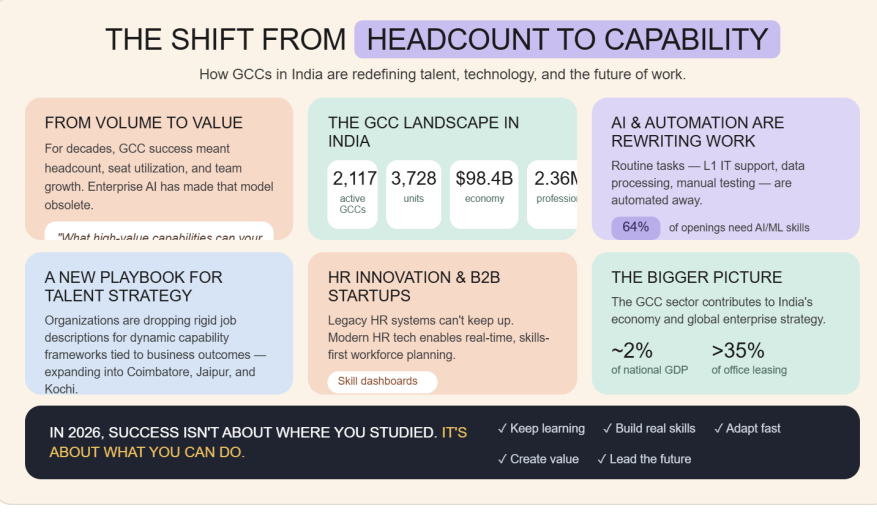
This paradigm shift creates an unprecedented window for HR innovation, accelerating market
adoption for high-growth B2B HR startups. Legacy workforce management software designed
around fixed organizational charts and manual headcount requests fails to capture dynamic
capability gaps. Modern HR tech startups building AI-driven skill-inventory dashboards, scenariobased workforce modeling tools, automated internal mobility platforms, and real-time compensation
analytics are achieving immediate enterprise adoption. These modern technologies allow talent
acquisition teams to cut skill-gap identification timelines from months down to weeks, equipping
enterprise leaders with data-backed workforce planning capabilities.