

Global Capability Centers (GCCs) are entering a new phase of evolution where governance is becoming
as important as innovation. As artificial intelligence continues to transform how businesses operate,
the way GCCs are managed, monitored, and scaled is also changing. In India alone, there are 1,900+
GCCs employing over 2 million professionals, and many of them are now leading global AI, data, and
automation initiatives.
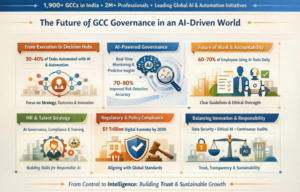
Today, with AI + automation handling 30–40% of repetitive enterprise tasks,
GCCs are taking on roles that directly impact business outcomes, customer experience, and global
strategy.

The future of GCC governance lies in integrating AI into governance itself. AI systems can monitor
operations in real time, detect anomalies, flag risks, and provide predictive insights.Studies suggest
that organizations using AI in governance functions can improve risk detection accuracy by up to 70–
80%, making decision-making faster and more reliable.
HR teams are responsible for embedding
governance principles into the organizational culture. This includes training employees on responsible
AI usage, data privacy, and compliance standards. AI-powered HR tools can also track employee
behavior patterns, monitor engagement, and flag potential risks such as policy violations or burnout.
Organizations
need professionals who understand not only technology but also ethics, compliance, and risk
management. India’s talent ecosystem, with over 1.5 million engineering graduates every year,
provides a strong foundation, but companies must invest in specialized training programs to build
governance capabilities at scale.
AI + automation are enabling faster growth, but they also introduce new risks such as data breaches,
algorithmic bias, and lack of transparency. The future of GCC governance must therefore balance
innovation with responsibility. Organizations need to build governance frameworks that include data
protection policies, ethical AI guidelines, audit mechanisms, and continuous monitoring systems.
Governance should not slow down innovation.
Many
multinational companies are assigning global AI mandates and decision-making responsibilities to
their Indian GCCs. This means that governance failures in one center can have global consequences.
On the other hand, strong governance frameworks can position Indian GCCs as trusted partners in
global innovation. With nearly 60–70% of employees expected to interact with AI tools in their daily roles, companies
must build clear guidelines that define human oversight and ethical boundaries.
In conclusion, the future of GCC governance in an AI world is about moving from control to intelligence.
It is about using AI-driven insights, strong talent strategies, and proactive compliance frameworks to
manage complex global operations. For B2B leaders and HR startups, this presents a significant
opportunity to support organizations in building robust governance systems. As GCCs continue to lead
global innovation, those with strong governance foundations will not only reduce risk but also build
long-term credibility and competitive advantage.