
India’s workforce is going through a major shift as two powerful forces rise together—the
creator workforce and the automation workforce. On one side, there is a growing group of
professionals building careers in content creation, design, digital media, and independent
online businesses. On the other side, automation powered by AI is transforming traditional
roles across industries. For Global Capability Centers (GCCs), businesses, and HR leaders,
understanding this balance is critical to shaping the future of work.
India today has over 1,900+ GCCs employing more than 2 million professionals, and these
centers are rapidly evolving from operational hubs to innovation-driven ecosystems. At the
same time, the creator economy in India is expanding quickly, with millions of young
professionals exploring careers in content, freelancing, and digital entrepreneurship. This
dual shift is redefining what work looks like, especially for graduates entering the job market.
One of the key GCC trends is the increasing use of AI + automation to handle repetitive and
process-driven tasks. Studies suggest that 30–40% of routine enterprise work can be
automated, including data entry, reporting, and customer support queries.
Young professionals are building careers as content creators, influencers, designers, video
editors, and independent consultants. This workforce values flexibility, creativity, and
personal branding. While traditional jobs offer stability, creator roles offer freedom and
potentially higher earning opportunities. For businesses, this creates a new talent dynamic
where individuals may not always prefer full-time roles.
Automation is improving
efficiency and productivity, while the creator economy is encouraging innovation and
individuality. Organizations that recognize this shift can design more flexible work models,
including hybrid roles, gig opportunities, and project-based work.
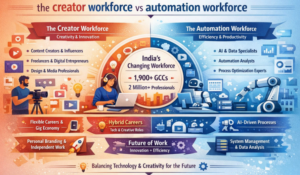
AI + automation and the creator workforce are not opposing forces; they are complementary.
Automation handles efficiency and scale, while creators drive innovation and engagement.
Businesses that understand this balance can build stronger, more adaptable workforce
strategies. For B2B leaders, the opportunity lies in integrating structured enterprise talent
with flexible creative talent to drive both productivity and innovation.
Government initiatives supporting digital
infrastructure, startup ecosystems, and skill development are encouraging both automation
and creator-driven growth. However, this also raises questions around job security, income
stability, and workforce regulation, especially for gig and creator roles.
In conclusion, the future of work in India is not about choosing between automation and
creativity. It is about combining both to build a dynamic, future-ready workforce. For GCCs,
HR startups, and enterprises, the focus should be on creating environments where
technology enhances efficiency and creativity drives value.