

Artificial intelligence is one of the most talked-about topics in boardrooms today, especially when it
comes to Global Capability Centers (GCCs). Many CEOs see AI as a fast-track solution to cut costs,
increase efficiency, and scale operations. While this is partly true, there are several key
misunderstandings that can slow down real impact.
Another common misconception is that AI will automatically reduce headcount. While AI + automation
can handle 30–40% of repetitive enterprise tasks, it does not eliminate the need for human talent.
Instead, it changes the nature of work

GCC trends clearly show a shift from execution-based roles to innovation-driven responsibilities. Many
CEOs still view GCCs as back-office centers, but this view is outdated. Today, GCCs in India are leading
AI development, cybersecurity operations, digital product engineering, and global analytics. This
means AI strategies must be designed with a long-term innovation mindset rather than short-term
efficiency goals.
AI adoption requires
employees to work alongside intelligent systems, but many organizations underestimate the
importance of preparing their workforce for this change. Studies suggest that 44% of core skills will
change by 2027, yet many companies do not invest enough in upskilling programs.
Some leaders assume that AI adoption
is purely a technology decision, but HR functions are deeply involved in making it successful. From
hiring AI talent to reskilling existing employees, HR teams must redesign workforce strategies. Modern
HR tech platforms use AI to track skills, predict attrition, and personalize learning paths
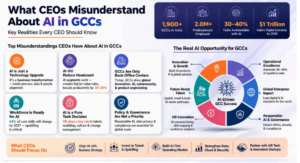
CEOs who ignore governance and compliance risks may face challenges in scaling AI initiatives across
regions. Responsible AI practices must be built into the strategy from the beginning.
India’s evolving role in global enterprise strategy further highlights why these misunderstandings
matter.
Many multinational companies are now assigning global AI mandates to their Indian GCCs.
These centers are not just executing tasks; they are shaping business decisions and customer
experiences worldwide. CEOs who recognize this shift can position their GCCs as strategic innovation
hubs rather than operational cost centers.
In conclusion, the biggest misunderstanding about AI in GCCs is viewing it as a quick fix rather than a
long-term transformation. AI requires alignment between technology, talent, HR strategy, and
governance frameworks. For B2B leaders and HR startups, the opportunity lies in helping
organizations move beyond surface-level adoption toward meaningful integration. When CEOs
understand the true potential of AI, GCCs can become powerful drivers of global innovation,
productivity, and sustainable growth