

One of the most important GCC trends is the shift from hiring ready talent to building talent
pipelines. Universities play a key role in this transformation. India produces over 1.5 million
engineering graduates every year, making it one of the largest talent sources globally.
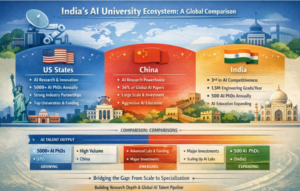
However, when compared to global leaders like the US and China, the depth of AI
specialization is still evolving. Reports suggest India produces fewer than 500 AI-focused
PhDs annually, while advanced economies produce significantly more.

As AI + automation take
over 30–40% of repetitive tasks, universities must prepare students Indian universities are
increasingly introducing AI, data science, and machine learning programs, but many are still
concentrated in top-tier institutions like IITs and IIITs. Expanding this access across Tier-2 and
Tier-3 colleges is essential for scaling workforce readiness.
Many companies report that
graduates require additional training before becoming job-ready for AI roles. This has led to
the rise of industry-academia partnerships, AI academies, and certification programs.
Organizations are collaborating with universities to co-design curriculum, offer internships,
and provide real-world project exposure.
Top institutions integrate AI across fields like healthcare, finance, and robotics, supported by
strong industry partnerships and research grants. China, on the other hand, has scaled its AI
education aggressively, contributing nearly 36% of global AI research output by 2025.
Countries like the US
emphasize research-led education, while China focuses on scale and infrastructure. India has
the opportunity to create a hybrid model—combining scale with innovation—by investing in
faculty training, research funding, and global collaborations.
AI + automation are also reshaping how universities themselves operate. Many institutions
are adopting AI-driven learning platforms, personalized education systems, and virtual labs.
This improves learning outcomes and prepares students for real-world AI applications.
Globally, universities are embedding AI into curriculum design, assessment methods, and
student engagement strategies.
GCCs are no longer just hiring from India; they are relying on Indian talent to lead
global AI projects. Many multinational companies are setting up innovation labs and research
centers in collaboration with universities. This positions India as not just a talent supplier, but
a co-creator in global AI innovation.
In conclusion, India’s AI university ecosystem is at a turning point. It has the scale,
momentum, and global relevance, but must continue to strengthen research depth,
infrastructure, and industry alignment. Compared to global leaders like the US and China,
India is catching up quickly but still has gaps to address.