

Artificial intelligence is transforming how Global Capability Centers (GCCs) operate, innovate, and
scale. From automating workflows to powering decision-making, AI is now deeply embedded in
enterprise strategy. In India alone, there are 1,900+ GCCs employing over 2 million professionals,
and many of them are leading global AI initiatives. However, as AI adoption grows, so does the need
for ethical frameworks.

One of the most important GCC trends today is the shift from efficiency-focused operations to valuedriven innovation.
20–30% productivity gains. But with this power comes responsibility. AI systems influence hiring
decisions, financial forecasting, customer interactions, and risk management.
AI models are only as good as the data they are trained on. If the data is biased, the outcomes will be
biased as well. Studies have shown that organizations that actively manage bias in AI systems can
improve diversity outcomes by up to 25–35%. GCCs must therefore implement regular audits, testing
frameworks, and validation processes to ensure fairness across all AI-driven decisions.
Data privacy and security are also central to ethical AI. With increasing amounts of data being
processed, GCCs must protect sensitive information and comply with global regulations. Strong data
governance frameworks, encryption standards, and access controls are essential. India’s digital
economy is expected to reach $1 trillion by 2030, and maintaining trust in data systems will be
critical to sustaining this growth.
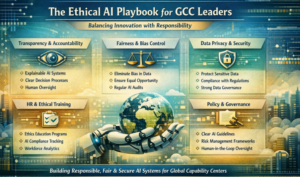
HR teams must design training programs that educate employees on responsible AI usage, data
handling, and compliance standards. AI-powered HR tools can also help monitor adherence to
policies, track employee behavior patterns, and identify potential risks. For HR startups, this creates
opportunities to build platforms that support ethical AI training, compliance tracking, and workforce
analytics
AI + automation are powerful tools, but they must be guided by clear principles. An effective ethical
AI playbook includes defined policies for data usage, clear accountability structures, continuous
monitoring systems, and mechanisms for addressing risks. It also includes human-in-the-loop models
where critical decisions are reviewed by people rather than left entirely to algorithms.
Many multinational companies are assigning global AI mandates to their Indian GCCs. This means
that decisions made within these centers can impact customers, employees, and markets
worldwide. Ethical lapses can damage brand reputation globally, while strong ethical practices
can position GCCs as trusted innovation partners.
In conclusion, the ethical AI playbook for GCC leaders is about balancing innovation with
responsibility. It is about building systems that are not only intelligent but also fair, transparent, and
secure. As AI continues to shape the
future of work, ethical governance will define which organizations succeed in the long run.