

Traditional outsourcing was built on a straightforward value proposition — transfer defined
work to a specialist vendor, pay for outputs rather than inputs, and benefit from the vendor’s
scale, process expertise, and lower labour costs. For decades, this worked well for functions
like IT helpdesk, finance and accounting processing, customer support, and basic software
maintenance.
The global outsourcing industry grew to enormous scale on the back of these
use cases, and India became its primary delivery engine. The country’s outsourcing sector still
generates significant economic value — the IT and business services export industry
contributes over $250 billion annually to India’s economy — and for specific, well-defined,
high-volume work, outsourcing continues to be an entirely rational choice.

The challenge is that the nature of the work that global enterprises need to do has changed
fundamentally. As digital transformation accelerated and AI moved from experimental to
operational, the functions that matter most to enterprise competitiveness — product
development, data architecture, AI model training, cybersecurity, and financial risk
management — became too strategically sensitive to hand to a vendor.
The intellectual property risks, the data security requirements, the need for institutional continuity, and the
desire to build proprietary capability that compounds over time all pointed in the same
direction — ownership, not outsourcing. India currently hosts over 1,700 GCCs employing 2.4
million professionals, and the majority of those centres exist because global enterprises
concluded that the work they needed done was too important to leave in someone else’s
hands.
The talent dynamics have reinforced this shift in a specific and important way. The best talent
in India’s major technology hubs increasingly prefers working for a captive GCC over a thirdparty outsourcing firm — partly because GCC roles offer greater ownership, more interesting
work, and clearer career trajectories, and partly because GCC compensation benchmarks have
risen to reflect the strategic value of the work being done.
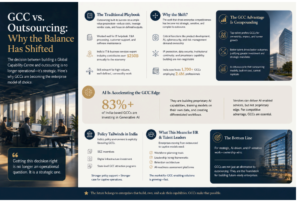
AI and automation are reshaping the competitive dynamics between the two models in ways
that favour the GCC. Over 83 percent of India-based GCCs are investing in Generative AI —
building proprietary AI capabilities, training models on their own data, and developing AI-driven
workflows that are specific to their enterprise context.
A third-party outsourcing vendor can
provide AI-enabled services, but the AI it deploys is not proprietary to any single client — it is a
shared capability that offers efficiency but not competitive differentiation. For enterprises
where AI is a source of competitive advantage rather than just operational efficiency, the GCC
model is not just preferable. It is necessary.
For HR startups and talent strategy leaders, the GCC-versus-outsourcing dynamic creates a
clear market signal. The organisations building those tools — with genuine understanding of what it means to manage a
captive operation rather than a vendor relationship — will find themselves serving the fastestgrowing and most commercially valuable segment of the Indian enterprise market.