
Today, India has become the world’s ultimate innovation powerhouse, driven by a massive,
highly skilled workforce and an unmatched ecosystem of capability centers. For fresh
graduates entering the job market and HR startups looking to scale modern workforce
solutions, understanding this shift is essential. India’s talent pool is no longer just executing
routine operations; it is defining the future of global enterprise strategy.
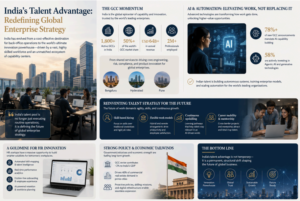
The momentum behind this shift is best captured by Global Capability Center (GCC) trends.
India currently hosts over 1,800 active GCCs, accounting for over 50% of the world’s total GCC
market share. Generating more than USD 64 billion in annual revenue and employing over 2
million professionals, these centers have moved far beyond shared services. Global giants in
banking, healthcare, retail, and manufacturing now build core engineering products, handle
global risk compliance, and architect software platforms directly out of Indian tech hubs like
Bengaluru, Hyderabad, and Pune.

Recent survey data shows that over 78% of new GCC announcements explicitly mandate AI
capability building, with 58% actively investing in Agentic AI and generative technologies.
Indian engineers, data scientists, and digital strategists are not merely implementing off-theshelf AI tools; they are building autonomous systems, training custom enterprise models, and
scaling automation for multinational firms. For young graduates, this creates an environment
where mastering AI and data literacy is no longer optional, but a prerequisite for career
progression.
This changing landscape demands fresh future-of-work thinking, forcing organizations to
reinvent their talent strategy. Navigating a hyper-competitive hiring market requires moving
past traditional multi-stage interview loops and rigid job roles. Instead, progressive businesses
focus on skill-based hiring, flexible hybrid arrangements, and continuous upskilling pathways.
High attrition rates and intense competition for niche technology skills mean companies can
no longer rely on brand reputation alone.
Traditional human resource management
systems are struggling to keep up with the demands of decentralized, AI-driven workplaces.
Today’s talent ecosystems require automated skill-mapping tools, real-time performance
analytics, friction-free onboarding platforms, and AI-powered retention prediction models. HR
startups that build solutions tailored to high-density GCC environments and rapid-scale hiring
hubs are finding a massive B2B market eager for smarter, faster human capital management
tools.
y support and favorable economic signals further solidify India’s long-term talent
dominance. Operating as a major growth engine, the GCC sector alone contributes roughly 2%
to India’s national GDP and drives 40% of commercial real estate demand across primary
cities. Furthermore, proactive government infrastructure projects, national skilling missions,
and digital public infrastructure have made operational expansion smoother than ever.