

Today, as global business models become increasingly complex, enterprise leaders must
evaluate whether relying on pure cost arbitrage remains a viable corporate strategy or has
degraded into an outdated myth. While baseline salary differentials still exist, treating savings
as the primary value driver actively undermines enterprise growth. Driven by policy and
economic signals such as streamlined safe harbour regulations, state-level GCC incentives,
and modernized bilateral trade frameworks, GCCs have systematically transcended the lowcost narrative.
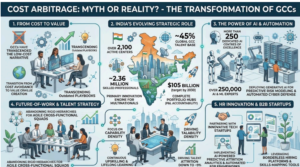
Hosting roughly 45% of
the global GCC talent base, India supports an ecosystem of over 2.36 million high-skilled
professionals, with market projections targeting $105 billion by 2030. Crucially, over 40% of
mature centers in India now operate as complete portfolio hubs, holding end-to-end P&L
accountability, owning intellectual property, and managing global engineering roadmaps. When
capability centers control entire product lifecycles and drive core business transformation,
evaluating them solely through a narrow lens of labor cost savings misrepresents their actual
enterprise value

Modern GCCs do not merely perform human-intensive tasks at a discount; they
build autonomous digital systems that power global operations. Today, India anchors more than
250 dedicated AI Centres of Excellence, powered by a specialized workforce of over 250,000 AI
and machine learning experts. By deploying generative AI for predictive risk modeling,
automated cyber defense, and real-time supply chain management, GCCs deliver exponential
operational speed and risk mitigation.
The financial ROI of an automated, risk-resilient
enterprise infrastructure vastly outweighs traditional salary savings, firmly putting the old
arbitrage argument to rest.
Transitioning from low-cost execution to high-impact value generation requires a complete
transformation in future-of-work thinking and talent strategy. To retain top-tier talent in hypercompetitive markets, forward-thinking GCC leaders have abandoned rigid, cost-bound
hierarchies in favor of agile, cross-functional squads. Hiring strategies no longer prioritize high
volume at low rates; instead, they focus on capability density, continuous upskilling, and deep
technical mastery.
This shift creates a high-growth horizon for HR innovation and specialized B2B startups.
Building value-driven, highly sophisticated GCC teams requires modern workforce
management infrastructure that goes far beyond legacy administrative HR software. Enterprise
decision-makers and CHROs are actively partnering with innovative tech startups to implement
AI-powered predictive attrition analytics, automated Employer of Record (EOR) frameworks,
borderless hiring platforms, and skills-mapping tools. By automating complex cross-border
payroll, tax optimization, and talent acquisition, these B2B startup solutions allow HR leaders
to build agile, change-ready workforces without getting bogged down in administrative
overhead.
Ultimately, cost arbitrage in the GCC landscape is neither purely myth nor complete reality—it
has simply been demoted from a primary strategy to an entry-level baseline benefit. While
initial cost savings help launch a center, long-term enterprise success depends on technical
capability, operational agility, and continuous innovation. Enterprise leaders, investors, and HR
innovators who move past the outdated cost-arbitrage mindset and invest in value-driven
capability hubs will build resilient, high-performing organizations built to lead in an
unpredictable global economy.