

For decades, landing a high-paying role in a premier multinational corporation required a familiar,
predictable formula: an elite degree from a top-tier university, impressive academic transcripts, and a
prestigious campus placement. However, as artificial intelligence reshapes daily corporate
workflows, the traditional credential-first recruitment model is rapidly dissolving. Enterprise talent
acquisition teams are realizing that a prestigious diploma guarantees theoretical knowledge, but it no
longer ensures real-time operational execution. For university graduates entering the market and HR
startups building modern recruitment engines, 2026 marks a decisive turning point: verifiable skills,
scenario-based problem-solving, and practical adaptability have permanently surpassed academic
degrees as the primary currency of career success.
This hiring revolution is directly anchored in the explosive expansion of Global Capability Center
(GCC) trends across India. The country currently hosts 2,117 active GCCs operating across 3,728
distinct units, representing a $98.4 billion market value and employing over 2.36 million skilled
professionals. Crucially, over 90% of these capability centers operate as multi-functional
innovation hubs, where local teams take direct global ownership of core cloud platforms, automated
risk engines, and enterprise IP. As these centers evolve from back-office support into primary digital
transformation engines, global executive boards can no longer afford to screen candidates using
slow, credential-heavy filters.

The rapid integration of AI and automation across candidate evaluation pipelines has accelerated
this shift toward capability-based hiring. Modern talent engines deploy skill-graph matching tools
that evaluate candidate portfolios, open-source code contributions, and practical scenario tests
rather than screening static resume keywords. With 64% of all new GCC job openings mandating
advanced AI, machine learning, or data science capabilities, the market faces a severe 53% talent
deficit in specialized AI roles, pushing voluntary tech churn rates up to 18% to 25%. In an
environment where companies project over 510,000 new GCC job openings in 2026 alone, relying
strictly on premier college degrees artificially constrains the talent pipeline.
Global organizations are shifting away from rigid job titles and degree
requirements, choosing instead to break work down into dynamic capability clusters such as cloud
infrastructure, platform reliability, and generative model evaluation. Simultaneously, enterprises are
expanding their technical footprints into secondary hubs like Coimbatore, Jaipur, and Kochi.
Operating in these expanding regional nodes allows organizations to tap into highly stable talent
pools while securing 10% to 15% lower attrition rates and 25% to 35% in overall operational cost
savings.
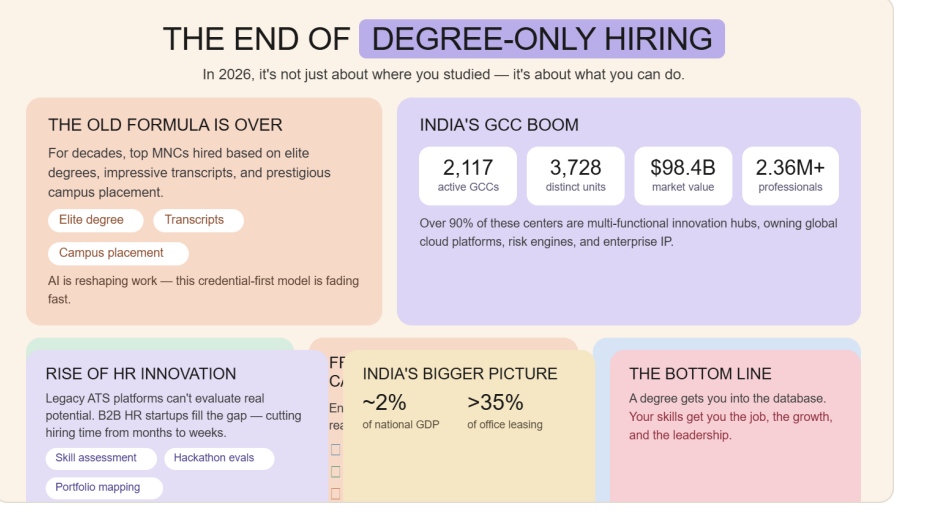
This structural transformation creates an extraordinary window for HR innovation, driving rapid
market demand for agile B2B HR startups. Legacy applicant tracking platforms that filter resumes
based on university names are entirely ill-equipped to evaluate real-world candidate potential. These modern recruitment platforms empower talent acquisition managers to
cut candidate evaluation timelines from months down to weeks, bringing data-backed precision to
talent discovery by assessing what candidates can actually do rather than where they studied.