

Today, the operational reality of GCCs
has undergone a total transformation. Driven by shifting market dynamics and favorable policy
and economic signals like modernized safe harbour tax revisions, state-level GCC policies, and
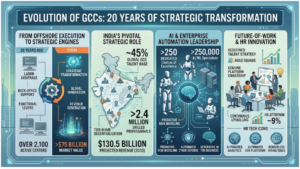
progressive trade frameworks, GCCs have evolved into strategic transformation engines. Over
the last two decades, the global GCC ecosystem has expanded into a massive enterprise force,
with over 2,100 active centers generating more than $75 billion in annual market value and
serving as the primary innovation engine for Fortune 500 companies worldwide.
Transitioning from a basic service delivery destination into the primary nerve
center for global product design, platform architecture, and enterprise governance, India now
hosts roughly 45% of the global GCC talent base. The historical numbers illustrate an
incredible growth trajectory: what began as a dispersed network of captive IT units now
employs over 2.4 million high-skilled professionals in India alone, with total revenue projected
to reach $130.5 billion by 2033.

Today, more than 250 dedicated Centres of Excellence across India
house over 250,000 AI and machine learning specialists who build autonomous digital
operating systems for global businesses. By deploying generative AI for predictive risk
modeling, automated cyber defense, and real-time financial clearing, modern GCCs insulate
parent organizations against supply chain volatility and macroeconomic disruptions,
transforming local operational units into intelligent command planes for the global enterprise.
Modern GCC leaders have abandoned rigid 20-year-old corporate hierarchies in favor of agile,
cross-functional squads trained in deep tech, product design, and strategic problem-solving. In
a hyper-competitive talent landscape where India produces over 2.5 million STEM graduates
annually, retaining top professionals requires offering genuine platform ownership, transparent
global career mobility, and flexible work models.
Managing modern, highly strategic GCCs demands
sophisticated workforce architecture that renders legacy HR administrative software obsolete.
Global executives and CHROs are actively partnering with agile HR tech startups to deploy AIpowered predictive attrition analytics, automated Employer of Record (EOR) platforms,
borderless talent acquisition tools, and tax-optimized compensation frameworks.
Capability centers are no longer
passive support units designed to trim expenses; they are multi-billion-dollar corporate assets
that power enterprise growth, continuous innovation, and long-term financial resilience.
Enterprise leaders, investors, and HR startups that embrace this mature, AI-driven paradigm
will not only navigate market disruptions with ease—they will shape the operating framework
for global commerce over the next twenty years.