

Across global corporate boardrooms, a persistent narrative suggests that artificial intelligence will
spark widespread job displacement and contract technology operations. However, actual enterprise
hiring data reveals a very different reality. Artificial intelligence is not eliminating Global Capability
Centers (GCCs); instead, it is permanently changing what these centers hire for. Rather than signaling
industry contraction, AI-driven automation is accelerating the structural transformation of Indian GCCs
—shifting workforce requirements away from high-volume transactional roles toward high-density
engineering, system design, and AI orchestration.
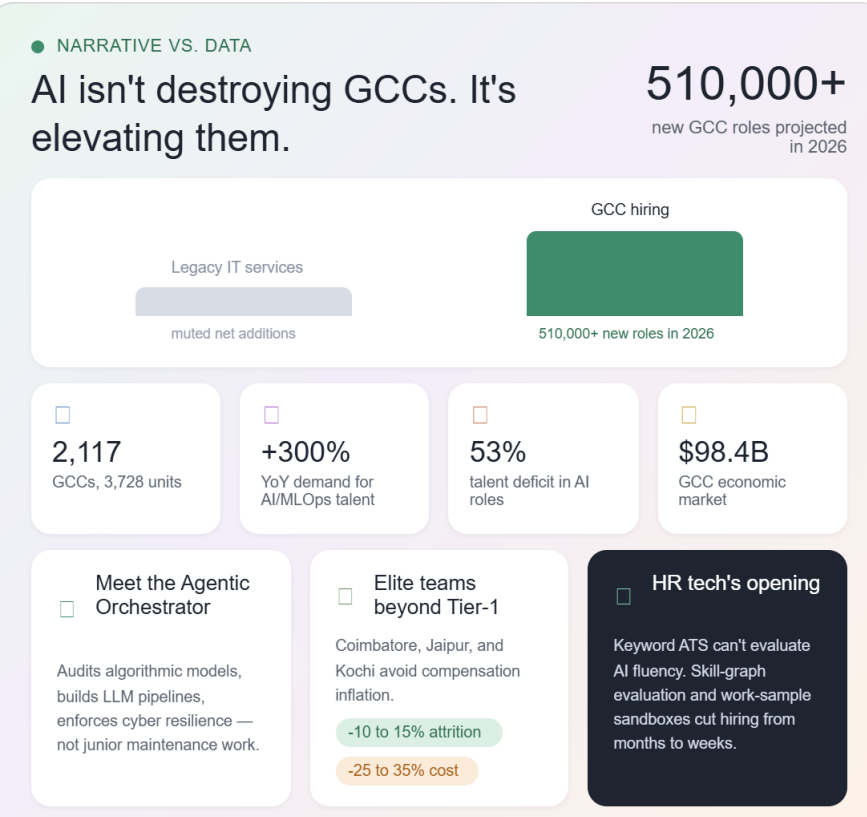
This talent evolution is taking place within a rapidly expanding economic sector. India currently hosts
2,117 active GCCs operating across 3,728 distinct units, forming a $98.4 billion economic market
that employs over 2.36 million skilled professionals.While legacy IT services firms face muted net
headcount additions, GCC hiring is projected to create over 510,000 new roles in 2026 alone.
Crucially, 64% of all new GCC openings explicitly mandate AI, data science, or intelligent
automation capabilities. As routine coding, basic QA testing, and manual data entry are automated
by intelligent software, GCCs are replacing generalist seat-fillers with high-capability specialists who
own global product roadmaps and manage complex AI architectures
The rapid integration of AI and automation across business infrastructure highlights an intense,
ongoing demand for specialist skills. Demand for AI, machine learning, and MLOps talent has surged
by over 300% year-over-year, colliding with an industry-wide 53% talent deficit in specialized AI
roles. Rather than hiring hundreds of junior engineers to maintain legacy software, GCCs are building
dedicated AI Centers of Excellence. Hiring managers are prioritizing “Agentic Orchestrators”—
professionals capable of auditing algorithmic models, building enterprise LLM pipelines, enforcing
cyber resilience, and translating raw AI capability into direct business value.
Adapting to this selective, high-value hiring landscape requires progressive future-of-work thinking to
restructure corporate talent strategy. Organizations are moving away from traditional headcount
targets, focusing instead on talent density and capability ownership.To assemble these elite specialist
teams without facing extreme compensation inflation in Tier-1 metros, global firms are expanding into
emerging secondary tech hubs like Coimbatore, Jaipur, and Kochi. Establishing specialized
engineering spokes in regional nodes enables GCCs to achieve 10% to 15% lower attrition rates
and secure 25% to 35% in overall operational cost savings, creating stable environments for
continuous learning and strategic mentorship
This pivot toward precision recruitment creates a massive window for HR innovation, accelerating
market adoption for agile B2B HR startups.Traditional applicant tracking tools relying on static
keyword matching cannot evaluate an engineer’s AI fluency or predict candidate joining intent. Highgrowth HR tech startups developing AI-driven skill-graph evaluation engines, live work-sample
sandboxes, real-time compensation intelligence dashboards, and predictive retention analytics are
achieving rapid enterprise integration. Modern platforms empower talent acquisition teams to cut
specialist hiring cycles from months down to weeks, bringing data-backed precision to talent
discovery.