

The global enterprise landscape has reached a defining structural turning point. For years, executive
teams framed Global Capability Centers (GCCs) in India as downstream delivery units—responsible
for executing software builds, managing back-office administration, and scaling technical infrastructure
under a cost-arbitrage mandate. However, in 2026, the traditional execution-only model is officially
obsolete. Global boardrooms are no longer just delegating operational tasks to India; they are
systematically transferring global decision-rights, product ownership, and strategic P&L governance to
Indian capability hubs.
This shift toward centralized decision-making is directly linked to the massive expansion of GCC
trends across India.The national ecosystem currently encompasses 2,117 active GCCs operating
across 3,728 distinct units, representing a $98.4 billion economic engine that employs over 2.36
million skilled professionals. Crucially, the functional maturity of these centers has reached an
unprecedented peak. Industry data highlights that over 90% of GCCs operate as multi-functional
innovation hubs, while nearly 96% of centers established since 2021 launched with direct
product and portfolio mandates rather than basic execution work.With 506 Forbes Global 2000
companies operating Indian GCC hubs, headquarters are entrusting local leadership with global
mandates because Indian teams possess the domain depth required to steer core business lines.

As routine code generation, basic financial reporting, and
level-1 IT support are systematically automated by intelligent agents, Indian GCCs are building
dedicated AI Centers of Excellence that govern autonomous enterprise workflows.With 64% of all
new GCC job openings explicitly mandating advanced AI or machine learning capabilities,
these centers attract the highest density of specialized engineering talent. Even as the ecosystem
manages an industry-wide 53% talent deficit in specialized AI roles and voluntary tech churn
between 18% and 25%, global boardrooms rely on Indian leaders to evaluate model safety, audit
algorithmic risk, and architect next-generation enterprise AI platforms.
Sustaining this strategic leadership model requires progressive future-of-work thinking to reshape
overall talent strategy. Organizations are replacing legacy volume-based metrics like raw headcount
growth with talent density and strategic influence.To build stable executive and engineering pods
without facing severe wage inflation in primary metros like Bengaluru and Hyderabad, global firms are
aggressively decentralizing operations into secondary technology hubs like Coimbatore, Jaipur, and
Kochi. Establishing specialized engineering spokes in these regional centers enables GCCs to achieve
10% to 15% lower voluntary attrition rates while securing 25% to 35% in overall operational
cost savings, creating stable environments where senior leaders can focus on long-term enterprise
strategy rather than constant recruitment.
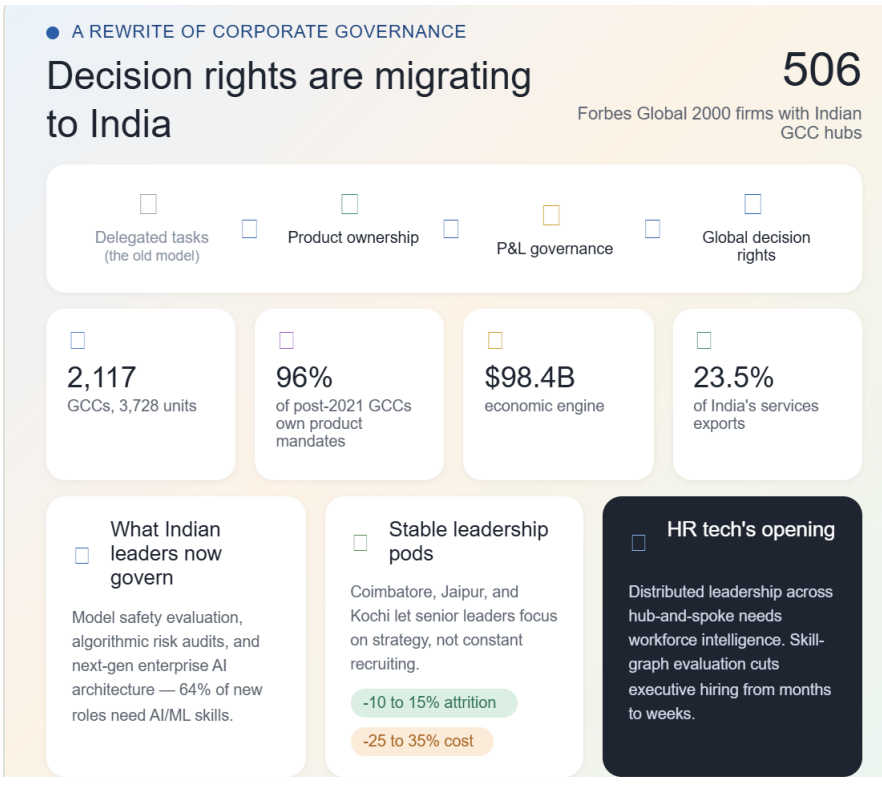
This migration toward global strategic governance presents an extraordinary growth vector for HR
innovation, driving rapid enterprise adoption for agile B2B HR startups. Managing distributed
leadership teams and specialized talent across hub-and-spoke networks requires next-generation
workforce intelligence platforms. High-growth HR tech startups developing AI-driven skill-graph
evaluation engines, contribution-based portfolio mapping, real-time compensation intelligence tools,
and predictive candidate retention analytics are seeing rapid integration. Modern platforms empower
talent acquisition leaders to cut executive and specialist hiring cycles from months down to weeks,
bringing data-backed precision to strategic headhunting.