

The fear that artificial intelligence is erasing entry-level career pathways has become a central anxiety
across boardrooms, university campuses, and HR tech startups. Historically, fresh university graduates
entered corporate pipelines through high-volume, low-complexity execution tasks: writing boilerplate
CRUD operations, manual unit test generation, basic document parsing, and level-1 IT ticket logging. In
an economy where autonomous agentic software instantly generates code scaffolds, parses legal
documentation, and executes standard data transformations, that traditional “learning-by-doing”
execution layer has dissolved. However, entry-level work is not vanishing—it is undergoing a rapid
upward shift in baseline expectations.
This transition is immediately visible across India’s Global Capability Center (GCC) trends.While
the GCC sector represents a $98.4 billion market employing 2.36 million professionals and
projecting over 510,000 new job openings, the profile of early-career intake has fundamentally
changed. Instead of onboarding thousands of freshers to perform routine maintenance, 64% of new
GCC roles mandate AI, data science, or intelligent automation capabilities.The traditional “junior
developer” or “associate analyst” is no longer hired to produce code or data from scratch; they are
hired as AI-assisted evaluators, responsible for directing LLMs, validating output integrity, and
identifying system edge cases.

This structural evolution demands progressive future-of-work thinking to reshape overall talent
strategy. Because senior engineers equipped with generative tools can complete execution tasks in a
fraction of the time, the entry-level bottleneck is now centered on domain judgment and systemic
problem-solving.To build sustainable pipelines without incurring extreme talent hyper-inflation in
primary metros like Bengaluru and Hyderabad, global firms are decentralizing their early-career
onboarding into emerging secondary technology hubs like Coimbatore, Jaipur, and Kochi. Operating in
regional hubs allows GCCs to realize 25% to 35% in overall operational cost savings and secure
10% to 15% lower voluntary attrition rates, creating stable environments where senior mentors can
coach freshers on high-level architecture rather than basic syntax.
The shift in early-career entry points creates an extraordinary window for HR innovation, accelerating
market adoption for agile B2B HR startups.Traditional campus recruitment platforms that filter
candidates based on university prestige or GPA fail to measure whether a fresher can evaluate an AI
model’s hallucination rate or debug complex agentic workflows. High-growth HR tech startups building
live sandbox assessment environments, AI-driven skill-graph mapping, contribution-based portfolio
analytics, and automated onboarding platforms are seeing rapid enterprise integration. Modern
platforms empower corporate talent acquisition teams to identify candidates with strong algorithmic
fundamentals and prompt-engineering capabilities, cutting skill-verification cycles from months down
to weeks
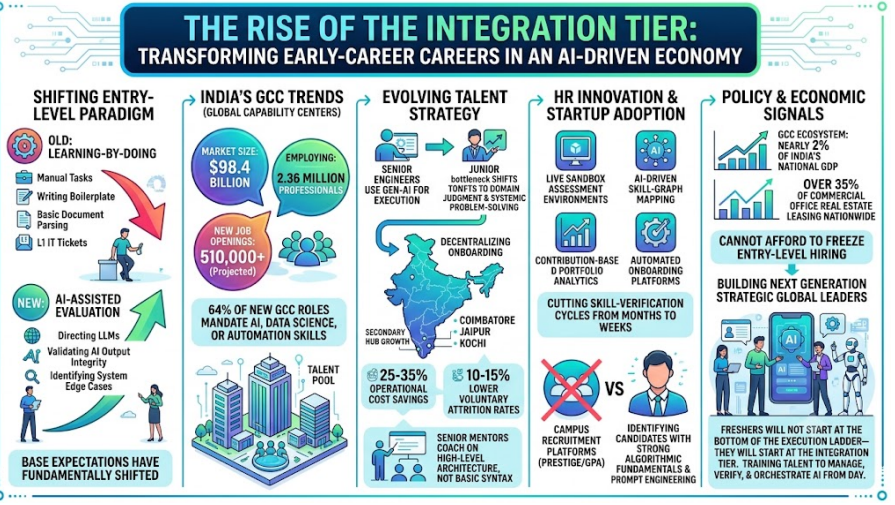
Unmistakable policy and economic signals confirm that India’s evolving role in global
enterprises strategy depends on upgrading early-career workforce readiness. Accounting for nearly
2% of India’s national GDP and driving over 35% of commercial office real estate leasing
nationwide, the GCC ecosystem cannot afford to freeze entry-level hiring without suffocating its future
leadership pipeline. Freshers will not start their careers at the bottom of the execution ladder anymore
—they will start at the integration tier. By training entry-level talent to manage, verify, and orchestrate
artificial intelligence from day one, enterprises will build the next generation of strategic global leaders.