

In corporate strategy and talent acquisition, asking whether a personal brand is replacing the
traditional resume often triggers intense debate. Purists argue that verifiable technical execution—
documented through formal degrees and past employment—remains the true foundation of
professional capability. However, as automated candidate sourcing platforms and algorithmic
evaluation tools redefine modern hiring pipelines, a static resume merely serves as a historical
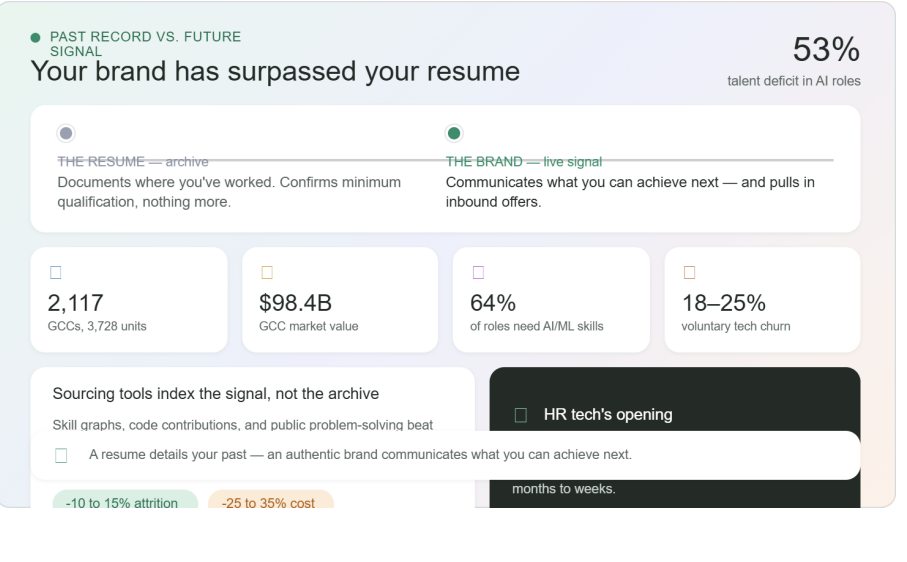
archive. While a well-formatted resume confirms that you meet minimum qualifications, an active
personal brand demonstrates your real-time problem-solving approach, domain influence, and
strategic vision.
This shift in how professional value is measured is closely tied to fast-evolving Global Capability
Center (GCC) trends. India currently hosts 2,117 active GCCs operating across 3,728 distinct
units, representing a $98.4 billion market and employing over 2.36 million skilled professionals.
Crucially, over 90% of these centers operate as multi-functional innovation hubs, where Indian
engineering leads manage core cloud platforms, global risk models, and enterprise product
roadmaps. In boardrooms where executives manage high-stakes international mandates, a passive
resume cannot capture strategic leadership presence.

Enterprise talent acquisition teams deploy intelligent sourcing
platforms to continuously scan web ecosystems, indexing talent based on skill graphs, verified code
contributions, and public problem-solving. With 64% of all new GCC job openings requiring
advanced AI or machine learning capabilities, the market faces a 53% talent deficit in specialized
AI roles, driving voluntary tech churn rates to 18% to 25%. In an environment where recruiters are
desperately searching for niche skills, a traditional resume often gets lost in high-volume application
databases, whereas a visible personal brand acts as a strong signal that attracts inbound enterprise
offers.
Adapting to this landscape requires progressive future-of-work thinking to reshape personal and
corporate talent strategy. Forward-thinking professionals manage their careers as dynamic digital
portfolios, regularly sharing contextual insights on system architecture, operational challenges, and
digital transformation initiatives. Simultaneously, global organizations are aggressively expanding
their technical footprints into emerging regional hubs like Coimbatore, Jaipur, and Kochi. Operating
in these expanding regional nodes—where operational costs are 25% to 35% lower and attrition
drops by 10% to 15%—allows talent with strong digital visibility to secure high-value global
leadership roles without needing to relocate to primary metropolitan hubs.
This dynamic presents a major window for HR innovation, driving rapid market adoption for agile
B2B HR startups. Legacy applicant tracking platforms that screen candidates based on keyword
density fail to capture authentic candidate engagement or domain authority. High-growth HR tech
startups developing AI-driven candidate discovery engines, contribution-based portfolio mapping,
real-time compensation intelligence tools, and predictive retention analytics are seeing rapid
enterprise adoption. Modern recruitment platforms empower talent acquisition managers to cut
candidate evaluation timelines from months down to weeks, bringing data-backed precision to
talent pipelines by locating high-caliber professionals through their active, value-adding digital
footprints.