
Current GCC trends highlight both significant progress and clear areas for growth. Global
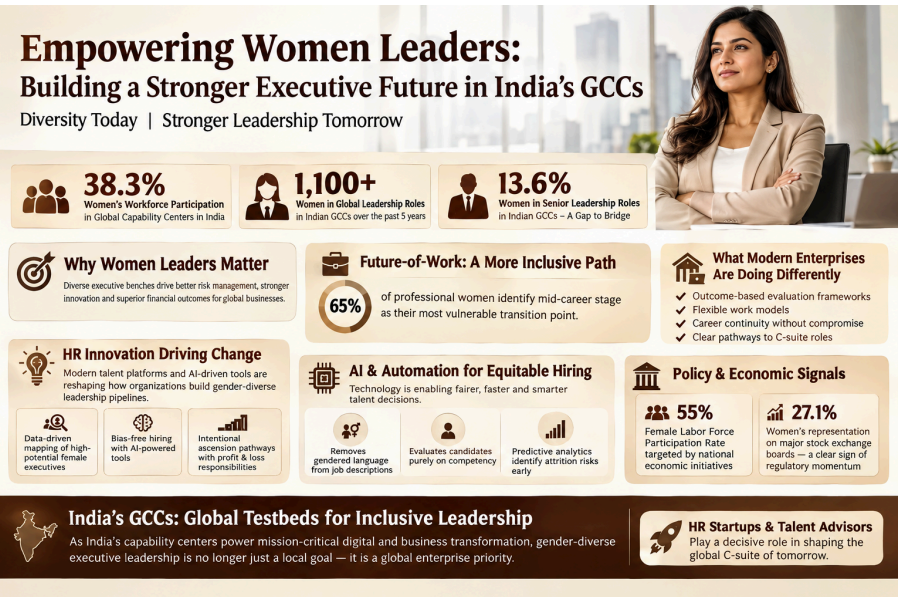
Capability Centers in India have become strong incubators for female talent, with overall
workforce participation among women rising to nearly 38.3%. Moreover, over 1,100 women
have stepped into global leadership roles within Indian centers over the past five years.
However, a persistent executive gap remains, as women hold roughly 13.6% of senior
leadership roles in these hubs. Bridging this gap requires specialized executive search
strategies tailored to support women through critical mid-career transitions.
Adopting modern future-of-work thinking is essential to fixing these structural leaks. Industry
data shows that 65% of professional women identify the mid-career stage as their most
vulnerable transition point, often due to rigid working models and caregiving pressures.
Future-focused enterprises are moving away from traditional presenteeism, replacing it with
outcome-based evaluation frameworks and flexible work models that allow top female talent
to maintain upward momentum toward C-suite roles without sacrificing career continuity.
At the same time, cutting-edge HR innovation is transforming how talent teams address
diversity gaps. Modern talent platforms leverage data analytics to map high-potential female
executives across industries, actively combating implicit biases in traditional networking
circles. Progressive talent strategies are also redesigning ascension pathways by intentionally
placing female leaders into direct profit-and-loss responsibilities rather than confining them
to support functions. This structural change ensures women gain the core commercial
experience required for board-level and chief executive appointments.
The integration of AI and automation is further accelerating this equitable hiring mandate.
Automated sourcing engines and AI-driven candidate assessment tools remove gendered
language from job descriptions and evaluate candidates purely on competency. Furthermore,
predictive engagement analytics help talent leaders identify attrition risks early, allowing HR
teams to intervene with targeted executive coaching, sponsorship programs, and leadership
development before valuable talent steps away.
These internal shifts are reinforced by supportive policy and economic signals. National
economic initiatives targeting a 55% female labor force participation rate identify flexible
working models and supportive corporate infrastructure as vital economic drivers. Beyond
compliance, progressive corporate governance guidelines have pushed female representation
on major stock exchange boards past 27.1%, proving that regulatory nudges create real
momentum across the corporate landscape.
Ultimately, India’s evolving role in global enterprise strategy position its capability centers as
global testbeds for inclusive leadership. As multinational organizations entrust Indian hubs
with mission-critical digital products and core business strategies, building gender-diverse
executive leadership is no longer just a local goal—it is a global enterprise priority. HR
startups and talent advisors that deliver robust, equitable leadership pipelines will play a
decisive role in shaping the global C-suite of tomorrow