

Measuring and improving diversity metrics has shifted from a superficial compliance exercise
into a foundational business driver for modern organizations. Historically, equity initiatives
relied on qualitative goals and vague promises, but global boardrooms now demand hard,
data-backed evidence. High-performing business units and scaling talent agencies understand
that tracking clear demographic, inclusion, and representation metrics is essential for longterm capability building and operational performance.
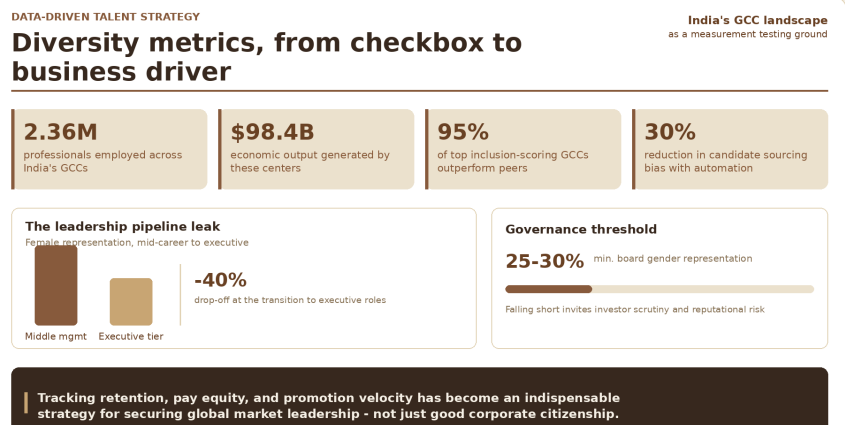
India’s GCC landscape, which employs 2.36 million professionals and generates $98.4 billion
in economic output, shows that inclusive organizations achieve higher employee
engagement scores. Industry assessments reveal that 95% of GCCs scoring highest on
empowerment and inclusion benchmarks consistently outperform their peers in innovation
and collaborative problem-solving. These centers demonstrate that tracking representation
across function and seniority levels directly strengthens an enterprise’s ability to build
complex global products.

Integrating diversity data into future-of-work thinking requires moving beyond basic
headcount tracking. True talent strategy looks deeply at retention rates, pay equity ratios,
promotion velocity, and leadership pipeline health across diverse employee groups. Modern
talent teams track key markers such as the mid-career retention rate, as research shows that
structural drop-offs often cause female representation to plummet by up to 40% between
middle management and executive tiers. Evaluating these transition points with granular data
allows organizations to fix systemic leaks in their talent pipelines.
At the core of this transformation is scalable HR innovation powered by modern software
tools. Advanced talent analytics platforms allow business leaders to move away from periodic
annual surveys toward continuous talent sensing. By examining cross-functional data, HR
startups can measure internal mobility metrics, candidate drop-off rates, and psychological
safety indicators in real time. Tracking internal mobility metrics ensures high-potential
employees from underrepresented groups access critical profit-and-loss roles, paving a clear,
measurable path toward executive leadership.
The rise of AI and automation further enhances how equity metrics are gathered and
analyzed. Machine learning models analyze job descriptions to remove biased language, while
algorithmic interview software standardizes evaluation frameworks to eliminate unconscious
candidate bias. Talent teams using automated recruitment analytics report a 30% reduction
in candidate sourcing bias and an increase in offer-acceptance rates among diverse talent
pools. Crucially, algorithms must be continuously audited for fairness to prevent embedded
biases from influencing executive talent mapping.
External policy and economic signals are reinforcing this shift toward rigorous diversity
measurement. Capital markets and corporate governance frameworks increasingly tie
enterprise valuation to environmental, social, and governance compliance. Regulatory bodies
now require public companies to disclose detailed representation data, pushing boardrooms
to maintain transparent diversity metrics. Consequently, companies that fail to maintain a
baseline of 25% to 30% gender representation on executive boards face increased scrutiny
from institutional investors and potential reputational headwinds.
Ultimately, India’s evolving role in global enterprise strategy positions its talent hubs as major
testing grounds for data-driven inclusion. As multinational corporations shift core R&D,
product ownership, and strategic decision-making to global capability centers, maintaining
transparent, actionable diversity metrics becomes essential. For talent startups and B2B
advisors, building systems that track, evaluate, and act on diversity data is no longer just good
corporate citizenship—it is an indispensable strategy for securing global market leadership.