

The conversation around Global Capability Centres has matured significantly over the last
few years. Industry leaders are no longer asking whether to build a GCC. Most of them have
already made that decision. The question they are asking now is more nuanced and far more
demanding — what does a great GCC partnership actually look like, and how do you build one
that delivers real strategic value rather than just operational efficiency? For HR startups,
talent leaders, and enterprise strategists, understanding what is at the top of that wish list is
the difference between building something relevant and building something that gets
replaced.
The single most consistent thing industry leaders say they want from GCC partnerships today
is co-ownership of outcomes. The old model — where a GCC was handed a set of tasks and
evaluated on whether those tasks were completed on time — is being rapidly phased out.
Global enterprises now expect their India-based teams to function as genuine business
partners who understand the bigger picture, contribute to strategic decisions, and take
accountability for results that go well beyond task completion.

Closely tied to this is the demand for AI-ready talent. Industry leaders are increasingly
frustrated when they set up GCC operations only to find that the talent available locally has
strong foundational skills but limited exposure to applied AI, automation governance, and
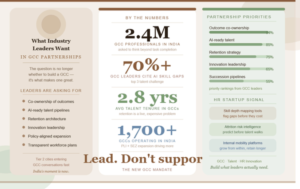
data-led decision-making. Recent industry surveys show that over 70% of GCC leaders cite AI
capability gaps as one of their top three talent challenges.
Trust and transparency in talent strategy are also rising up the priority list. Industry leaders
want to know exactly how their GCC partner is approaching workforce planning, attrition
management, and succession pipelines. With average GCC talent tenure sitting at roughly 2.8
years, retention is a live and expensive problem. Enterprises are not just asking for
headcount.
Industry leaders are paying close attention to these signals because they directly affect
where capability can be built, at what cost, and with what regulatory confidence. Tier 2 cities
are entering these conversations more frequently as infrastructure improves and talent costs
in metros continue to rise. This shift in expectation is driving significant changes in how GCCs
are structured, how leadership is hired, and how performance is measured.
The Indian government’s continued investment in digital infrastructure, the expansion of
Special Economic Zones, and the push through the PLI scheme across sectors like
semiconductors, electronics, and green energy are giving global enterprises more reasons
and more locations to build.
Enterprises are not coming to India just to execute on ideas that were born elsewhere. They
are expecting their GCC teams to identify problems, design solutions, and drive adoption
across the global organisation. This is a fundamentally different value proposition from the
one that defined GCCs a decade ago. For India, it represents an extraordinary opportunity.
For HR leaders and the startups building tools to support them, it is a clear signal of where
the next wave of enterprise investment is heading — and who will be ready to meet it.