

There is no single right answer when businesses ask whether to outsource or build a captive
centre. The honest answer is that it depends entirely on what your industry needs to protect,
what it needs to grow, and how fast the competitive landscape around you is moving. As India
continues to mature as a global enterprise destination, the outsourcing versus captive debate
is becoming one of the most strategically important decisions business leaders and HR teams
will make in the next five years.
. Retail, e-commerce, logistics, and customer service companies still find
outsourcing to be an efficient and flexible model.Paying a third-party vendor to manage
customer support, last-mile logistics coordination, or back-office processing makes economic
sense when the work is standardised and does not touch sensitive intellectual property. The
outsourcing market in India alone is valued at over $250 billion and continues to grow, which
tells you clearly that this model is far from obsolete.

Banking, financial services, and insurance companies are
leading this shift. With data privacy regulations tightening globally and cybersecurity threats
rising, BFSI firms simply cannot afford to hand over sensitive financial operations to third
parties. Over 40% of India’s GCCs today are in the BFSI and technology sectors, and that
concentration is not accidental. It reflects a deliberate strategic choice to keep critical
functions in-house while still benefiting from India’s deep talent pool.
Compliance-heavy work,
drug research support, clinical data management, and regulatory documentation require a
level of internal control and institutional knowledge that outsourcing cannot reliably provide.
These companies are building GCCs that function almost like internal centres of excellence,
where domain expertise is built and retained over years rather than cycled through a vendor
relationship.
Technology companies tend to adopt a more nuanced hybrid approach. They keep product
engineering, AI research, and core platform development within captive centres while
outsourcing non-core functions like IT helpdesk, testing, or content moderation. This model
gives them the innovation control they need without carrying unnecessary fixed costs across
every business function. Manufacturing firms are increasingly following this same hybrid
logic, pairing outsourced supply chain operations with captive engineering and R&D teams
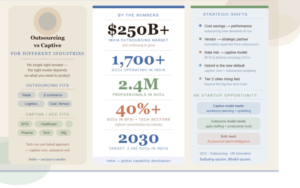
For HR startups and talent strategy leaders, this industry-by-industry divergence creates
both complexity and opportunity. Companies moving toward captive models need long-term
workforce planning, leadership hiring pipelines, retention architecture, and continuous
upskilling programmes. Outsourcing-heavy companies need agile staffing solutions,
productivity benchmarking tools, and vendor talent quality assessment frameworks.