

For generations, career advancement followed a rigid, active ritual. Professionals spent endless hours
polishing resumes, browsing job portals, and submitting hundreds of blind applications, hoping a hiring
manager might notice them. However, as enterprise hiring transitions to intelligent data pipelines,
proactive candidate searching is quietly becoming obsolete. Instead of candidates chasing companies,
modern talent acquisition engines are designed to locate, evaluate, and approach qualified individuals
automatically. For recent university graduates and ambitious professionals, this shift introduces an
inspiring possibility: what if your next career-defining opportunity finds you long before you ever decide
to apply?
This reversal in hiring dynamics is directly tied to accelerating Global Capability Center (GCC)
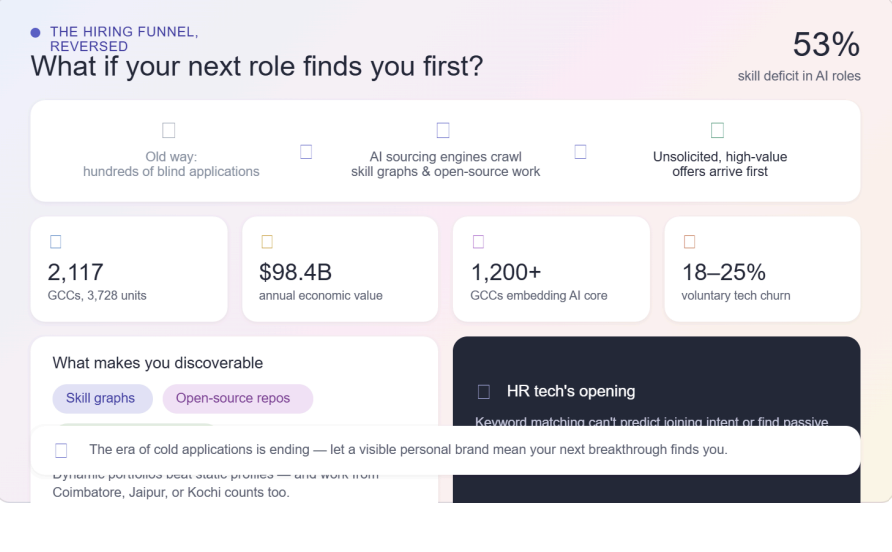
trends across India.The country currently hosts 2,117 active GCCs operating across 3,728 units,
generating $98.4 billion in annual economic value and employing over 2.36 million skilled
professionals. Crucially, over 90% of these capability hubs operate as multi-functional
innovation hubs, where Indian engineering teams own global cloud architectures, manage enterprise
risk models, and direct core product engineering. As international enterprises expand their presence in
India, corporate talent acquisition teams are actively monitoring public technical contributions, looking
to identify high-performing talent before positions are publicly listed.

The primary catalyst enabling inbound recruitment is the integration of AI and automation across
candidate sourcing platforms. Modern recruitment stacks use machine learning to crawl web
ecosystems, indexing professionals based on skill graphs, open-source repositories, and verified
domain contributions.With over 1,200 GCCs embedding AI capabilities into their core
operations, demand for specialized technical talent has created a 53% skill deficit in AI roles,
driving voluntary tech churn rates up to 18% to 25%. In a market where recruiters are desperately
searching for niche capabilities, passive job seekers with clear digital footprints are routinely targeted
with unsolicited, high-value global offers.
Capitalizing on inbound opportunities requires forward-looking future-of-work thinking to rebuild
personal and enterprise talent strategy. Professionals can no longer afford to maintain static digital
profiles; they must build dynamic digital portfolios that demonstrate real-world problem-solving.
Simultaneously, global enterprises are aggressively expanding into emerging regional technology hubs
like Coimbatore, Jaipur, and Kochi. Operating in these regional tech nodes allows organizations to tap
into stable candidate pools while benefiting from 10% to 15% lower attrition rates and 25% to 35%
in overall operational cost savings. In these growing markets, professionals who build visible
domain authority can easily attract enterprise opportunities without relocating to primary metros.
This shift presents a massive window for HR innovation, accelerating market demand for high-growth
B2B HR startups. Legacy recruitment systems that screen candidates based solely on keyword
matching fail to predict candidate joining intent or identify passive talent. High-growth HR tech startups
developing AI-driven candidate discovery tools, real-time compensation intelligence dashboards,
contribution-based portfolio mapping, and predictive retention analytics are achieving rapid enterprise
adoption. Modern HR tools empower talent acquisition managers to cut candidate identification
timelines from months down to weeks, bringing hidden, high-caliber candidates directly into highimpact talent pipelines.