

The widespread availability of Generative AI tools has completely rewritten the economics of digital
communication. With a simple prompt, anyone can generate endless blog posts, technical
summaries, or social media updates within seconds. However, as digital channels become flooded
with synthetic text, a clear counter-trend has emerged across executive boardrooms: commodity
content has lost its value, while authentic original thinking has become exceptionally high-value. For
recent university graduates entering the workforce and HR startups designing agile recruitment tools,
this dynamic presents a fundamental shift.
This shift in intellectual value is directly linked to fast-evolving Global Capability Center (GCC)
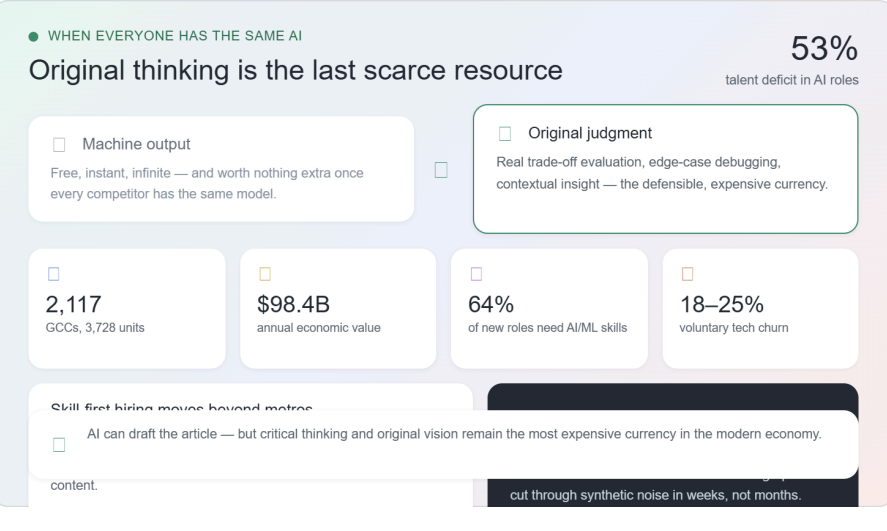
trends. India currently hosts 2,117 active GCCs operating across 3,728 distinct units, generating
$98.4 billion in annual economic value and employing over 2.36 million skilled professionals.
Crucially, over 90% of these capability centers operate as multi-functional innovation hubs,
taking direct global ownership of complex cloud architectures, automated risk models, and core
enterprise IP.
The massive integration of AI and automation across business infrastructure further highlights why
original thought is so critical. Within the GCC ecosystem, 64% of all new job openings explicitly
require advanced AI, machine learning, or intelligent automation capabilities. However, an
industry-wide 53% talent deficit in specialized AI roles has pushed voluntary tech churn to 18% to
25% for high-demand engineers. In a market where candidates use AI to generate polished resumes
and generic cover letters, traditional hiring filters break down. Enterprise teams are increasingly
uninterested in generic responses; they are searching for professionals who understand real-world
system failures, edge-case debugging, and unique architectural methodologies.
Navigating this reality requires progressive future-of-work thinking to reshape enterprise talent
strategy. Forward-thinking business leaders recognize that relying on AI for routine execution is
essential, but evaluating employees based solely on output volume is a mistake. Companies are
establishing skill-first evaluation frameworks and expanding engineering footprints into regional
technology hubs like Coimbatore, Jaipur, and Kochi. Operating in these emerging tech nodes allows
organizations to tap into highly stable talent pools while benefiting from 10% to 15% lower attrition
rates and 25% to 35% in overall operational cost savings.
This talent filter creates an extraordinary window for HR innovation, driving rapid enterprise demand
for agile B2B HR startups. Legacy applicant tracking platforms that screen candidates based on
keyword density are easily gamed by AI-generated resumes. High-growth HR tech startups
developing AI-driven skill-graph assessment tools, real-time candidate contribution evaluation
engines, automated portfolio mapping, and predictive retention analytics are seeing rapid adoption.
Modern HR technology enables hiring teams to cut candidate assessment timelines from months
down to weeks, allowing talent acquisition leaders to cut through synthetic noise and identify
candidates with genuine, original problem-solving capabilities.