

Sustainability used to be the chapter at the back of the annual report that nobody read
carefully. That era is over. For global enterprises operating GCCs in India, Environmental,
Social, and Governance considerations have moved from a compliance checkbox to a core
strategic priority — one that is influencing everything from where GCCs are built and how
they are powered, to how they hire, how they measure performance, and how they tell their
story to employees, investors, and regulators.

The environmental dimension of GCC ESG strategy is becoming genuinely complex. Global
enterprises have made ambitious net-zero commitments — over 80 percent of Fortune 500
companies now have published sustainability targets — and their India operations are
expected to contribute to those targets, not contradict them. This means GCCs are under
pressure to transition to renewable energy sources, reduce their office carbon footprints,
achieve green building certifications, and implement rigorous scope three emissions
reporting.
India’s renewable energy ecosystem is well-positioned to support this agenda — the country
has set a target of 500 gigawatts of renewable energy capacity by 2030, and the cost of solar
and wind power has fallen dramatically in recent years, making clean energy sourcing
genuinely viable for commercial operations at GCC scale
The social dimension of ESG is where HR leaders and talent strategists have the most direct
influence — and where the most significant opportunities for differentiation exist. Global
enterprises are being held to account for gender diversity ratios, pay equity across
demographics, inclusive hiring practices, employee mental health and wellbeing
investment, and community impact programmes at their India operations. The talent market
is responding to this accountability — particularly among younger professionals who are
increasingly evaluating employers on ESG credentials alongside compensation and career
development.
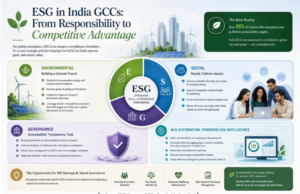
AI and automation are reshaping the ESG monitoring and reporting function in ways that
create direct demand for Indian GCC talent. The ability to aggregate ESG data across complex
global supply chains, model carbon footprint scenarios, run diversity analytics, and produce
regulatory-compliant sustainability reports requires significant data engineering and
analytical capability. Over 83 percent of India-based GCCs are investing in Generative AI, and
a growing share of that investment is being directed toward ESG intelligence platforms that
can automate reporting, flag compliance risks, and generate board-ready sustainability
insights.
For HR startups and talent innovators, the ESG agenda inside GCCs creates a clear and
commercially promising product mandate. Enterprises need diversity and inclusion analytics
tools, pay equity monitoring platforms, employee wellbeing measurement systems, and
ESG-linked performance management frameworks that are calibrated to the Indian GCC
context. Generic global ESG tools often fail to account for the specific regulatory
environment, cultural context, and workforce demographics of India operations — creating a
genuine gap that India-specific HR innovators are well-positioned to fill