

India’s rise as the global hub for Global Capability Centers (GCCs) is no longer just a
prediction—it is becoming a business reality. Over the last decade, multinational companies
have increasingly chosen India to establish centers that manage technology, operations,
finance, human resources, customer experience, and innovation functions. By 2030, India is
expected to host more than 2,500 GCCs, up from approximately 1,800 today, employing over
4.5 million professionals and contributing significantly to the country’s economic growth.

One of the strongest GCC trends shaping the next decade is the shift toward high-value work.
Earlier generations of GCCs focused primarily on support functions. Today’s centers are
responsible for advanced analytics, artificial intelligence, cybersecurity, cloud engineering,
product development, and business strategy. As organizations continue to invest in digital
transformation, India is becoming a key destination for highly specialized talent capable of
managing complex global operations.
Hybrid work models, digital
collaboration tools, and distributed teams have enabled organizations to access talent
beyond major metropolitan cities. By 2030, companies are expected to build talent
ecosystems across Tier-2 and Tier-3 cities, creating new employment opportunities while
reducing hiring pressures in traditional business hubs. This geographic expansion will help
organizations access skilled professionals at scale while supporting more inclusive economic
development.
As talent competition
intensifies, organizations are investing heavily in employee experience, learning platforms,
workforce analytics, and skills-based hiring models. Traditional job descriptions are gradually
being replaced by capability-driven talent frameworks that focus on adaptability, digital skills,
and continuous learning. HR teams are increasingly using data-driven insights to improve
recruitment, retention, and workforce planning, helping organizations build resilient talent
pipelines for the future
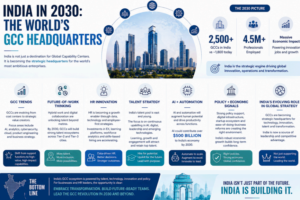
By 2030, India’s role in global enterprise strategy will be fundamentally different from what it
was a decade earlier. GCCs will not simply support headquarters located elsewhere—they will
increasingly function as strategic headquarters themselves for technology, innovation, talent,
and business transformation. Global executives are already recognizing India as a source of
leadership, innovation, and competitive advantage rather than just operational efficiency.
The journey toward becoming the world’s GCC headquarters is being driven by a powerful
combination of talent, technology, innovation, and policy support. For businesses, HR
startups, and enterprise leaders, the message is clear: India’s GCC ecosystem is not just
growing—it is becoming one of the most important engines of global business success.
Organizations that align their talent strategies, embrace AI-driven transformation, and invest
in future-ready workforce models today will be best positioned to lead in the GCC landscape
of 2030 and beyond