

The rapid integration of artificial intelligence across corporate software pipelines has sparked an
intense debate in talent acquisition: if autonomous software agents and predictive tools can write basic
code, write unit tests, run L1 IT support, and summarize data, should enterprises cut back on fresher
hiring? At first glance, cutting entry-level intake appears to be a logical cost-saving move. However,
companies that pause or drastically reduce their entry-level hiring pipeline to chase short-term AI
efficiency are making a dangerous strategic trade-off—one that trades immediate productivity for
severe mid-level leadership deficits, broken internal talent pipelines, and sky-high future replacement
costs.
This talent pipeline dilemma is playing out directly across Global Capability Center (GCC) trends in
India. India currently hosts 2,117 active GCCs operating across 3,728 distinct units, forming a $98.4
billion economic sector that employs over 2.36 million skilled professionals.While overall GCC
hiring is projected to cross 510,000 new roles in 2026 alone, the entry-level hiring mix is
undergoing a permanent structural shift.While IT services companies have reduced traditional massscale campus intakes, capability centers are realizing that cutting freshers entirely creates an
unsustainable talent gap.To maintain operational continuity, forward-thinking GCCs are shifting from
high-volume “seat-filling” fresher intake to high-signal “AI-ready” fresher hiring.

The primary catalyst altering the entry-level hiring equation is the deployment of AI and automation
across software engineering and operational workflows. Routine tasks that once justified massive junior
intakes—such as manual QA testing, basic bug fixing, and boilerplate data entry—are now handled by
intelligent software.With 64% of all new GCC job openings explicitly requiring AI, machine
learning, or automated workflow capabilities, the bar for entry-level talent has risen. Companies
should not hire fewer freshers; instead, they must hire freshers with higher baseline readiness who can
act as “AI Orchestrators” from day one, using generative tools to accelerate output while learning the
complex business domain.
Navigating this entry-level transition requires progressive future-of-work thinking to reshape
enterprise talent strategy. Stopping fresher intake creates an immediate “experience void” three to
five years down the line. Relying solely on senior lateral hiring leads to severe wage inflation, high
poaching risks, and intense competition for mid-level leaders.To build sustainable talent pipelines
without incurring hyper-inflation in primary metros, global firms are expanding fresher incubation labs
into emerging secondary technology hubs like Coimbatore, Jaipur, and Kochi. Establishing regional
training pods enables GCCs to achieve 10% to 15% lower attrition rates and 25% to 35% in overall
operational cost savings, creating stable environments where junior engineers can learn institutional
domain context.
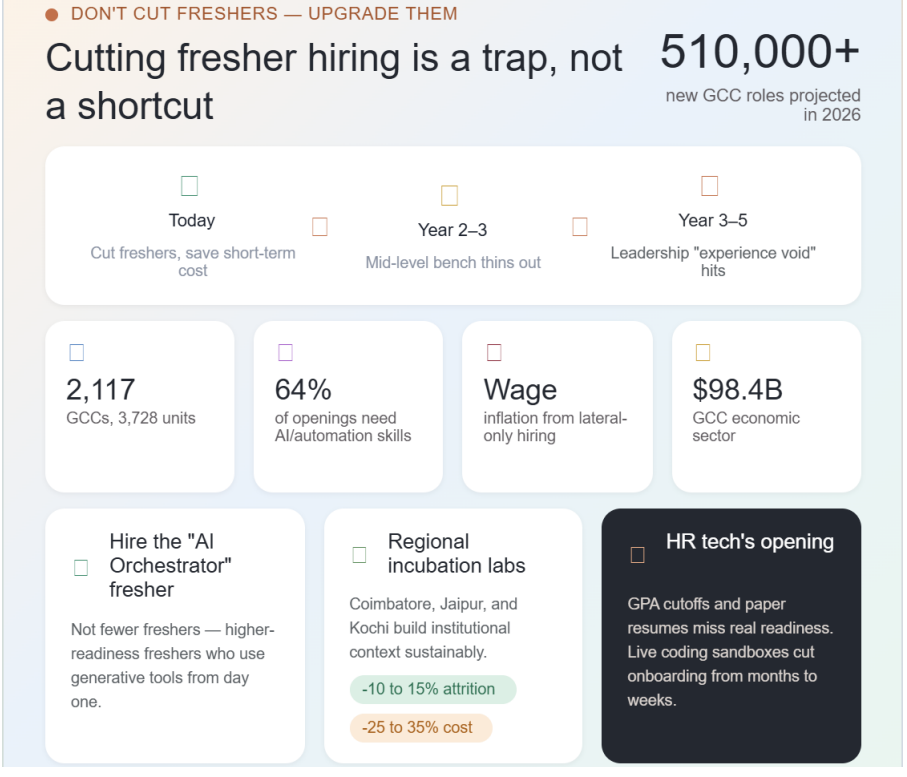
This shift in fresher screening represents a massive opportunity for HR innovation, driving rapid
market adoption for agile B2B HR startups. Legacy campus recruitment models relying on GPA
cutoffs and paper resumes fail to measure an applicant’s practical problem-solving ability or AI fluency.
High-growth HR tech startups developing AI-driven skill-graph evaluation engines, live coding
sandboxes, contribution-based portfolio mapping, and predictive candidate readiness analytics are
seeing rapid enterprise integration. Modern assessment platforms empower talent acquisition teams to
evaluate thousands of graduates on deployable technical capability rather than academic pedigree,
cutting fresher onboarding timelines from months down to weeks.