

The prevailing narrative in corporate talent strategy suggests that artificial intelligence is creating an
unprecedented skills gap overnight. Every executive presentation highlights the sudden, desperate
search for specialized prompt engineers, MLOps architects, and neural network auditors. However,
evaluating enterprise workforce data in 2026 reveals a far uncomfortable reality: AI is not creating a new
skills gap. Instead, generative systems and autonomous agents are simply exposing the legacy
structural deficiencies, outdated training pipelines, and artificial credential filters that corporate human
resources relied on for decades.
This distinction is clearly demonstrated across India’s evolving Global Capability Center (GCC)
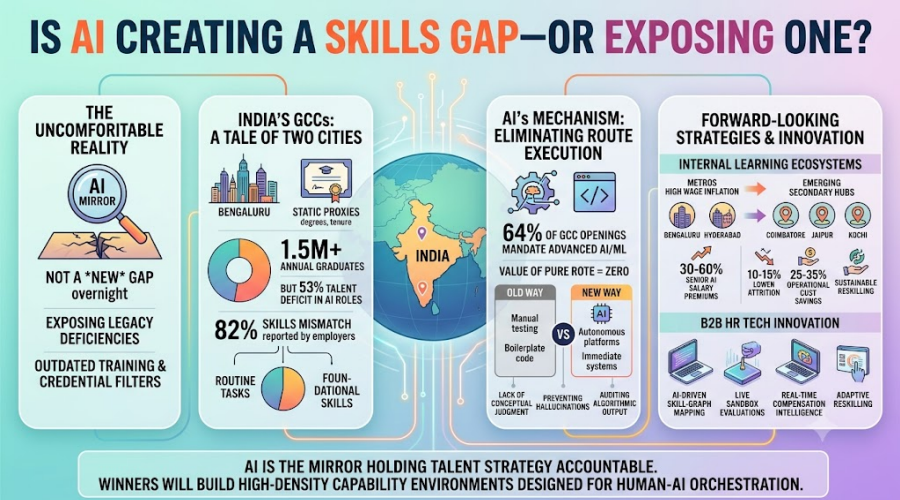
trends.The country currently hosts 2,117 active GCCs employing 2.36 million professionals within
a $98.4 billion economic market. Historically, enterprise hiring relied on university prestige, static
diplomas, and raw years of tenure as proxy metrics for competence.Yet, despite producing over 1.5
million engineering graduates annually, industry benchmarks indicate an immediate 53% talent
deficit in specialized AI roles and an overall 82% skills mismatch reported by employers.The
talent hasn’t vanished; rather, automated systems have eliminated the routine execution tasks that
previously masked a widespread lack of foundational problem-solving abilities, systemic architectural
understanding, and domain judgment.
The primary mechanism exposing this talent gap is the rapid integration of AI and automation across
operational business units. In a traditional software delivery environment, an engineer could spend
years performing manual regression testing, rewriting boilerplate code, or formatting API endpoints
without ever designing a complex system from scratch.Today, with autonomous platforms generating
standard code scaffolds instantly, the value of pure rote execution has fallen to zero.With 64% of all
new GCC job openings mandating advanced AI or machine learning capabilities, organizations
are discovering that many mid-level engineers lack the deep conceptual judgment required to audit
algorithmic outputs, manage MLOps pipelines, or prevent model hallucinations.
Addressing this reality requires progressive future-of-work thinking to rebuild overall talent strategy.
Forward-looking enterprises are recognizing that attempting to solve the talent deficit purely through
external headhunting in primary metros like Bengaluru and Hyderabad leads to unsustainable wage
inflation, with senior AI roles commanding 30% to 60% salary premiums.To build sustainable internal
learning ecosystems, global firms are decentralizing their operations into emerging secondary hubs like
Coimbatore, Jaipur, and Kochi. Establishing specialized learning spokes in these regional centers
enables GCCs to achieve 10% to 15% lower voluntary attrition rates and 25% to 35% in overall
operational cost savings, creating stable environments where firms can systematically reskill existing
talent rather than endlessly competing in hyper-inflated recruitment markets.
The realization that AI exposes existing talent vulnerabilities creates a massive window for HR
innovation, accelerating market adoption for agile B2B HR startups. Legacy applicant tracking
systems designed to screen resumes based on keyword matching or university names cannot measure
real-world technical adaptability. High-growth HR tech startups developing AI-driven skill-graph
mapping, live sandbox work-sample evaluations, real-time compensation intelligence tools, and
adaptive internal reskilling platforms are achieving rapid enterprise integration. Modern platforms
empower workforce planners to identify hidden candidate potential, assess core logic over rote
memorization, and cut skill-gap verification timelines from months down to weeks.