

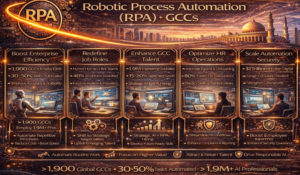
Over the past decade, GCCs have evolved rapidly. India alone hosts 1,900+ GCCs,
employing over 1.9 million professionals, and contributing significantly to the country’s
ambition of building a $1 trillion digital economy by 2030. What started as IT support and
shared services centers has now expanded into analytics, AI engineering, cybersecurity,
product development, and automation excellence. RPA is central to this shift because it
enables GCCs to automate repetitive, rule-based processes across finance, HR,
procurement, compliance, and customer operations.
From a GCC trends perspective, enterprises are moving from simple task automation to
intelligent automation. It is integrated with AI, machine learning, and analytics to create
smarter workflows. Industry estimates suggest that 30–50% of repetitive enterprise tasks
can be automated using RPA and related technologies.

The future workforce inside GCCs will require skills in automation management, data
interpretation, exception handling, and digital governance. This transition creates new
job categories such as automation architects, bot supervisors, and process optimization
analysts. According to global workforce studies, nearly 40% of employees will need
reskilling in digital capabilities within the next five years to stay relevant in AI-powered
environments.
RPA is also being deployed within HR functions themselves,
automating onboarding documentation, payroll processing, background verification
workflows, and compliance reporting. This not only reduces administrative burden but
improves employee experience. Faster onboarding and seamless HR operations directly
impact retention and engagement metrics.
Demand for skills in AI, automation testing, data analytics, and process re-engineering is
growing at double-digit rates in many markets. In India, the demand for digital talent in
GCCs has been increasing by 15–20% annually, reflecting the country’s growing
importance in global enterprise strategy.
Many global organizations are centralizing their automation centers of excellence in
Indian GCCs. This shift reflects trust in India’s engineering talent, mature IT ecosystem,
and experience in large-scale digital transformation. As automation adoption
accelerates globally, GCCs in India are expected to lead implementation, governance,
and innovation efforts.
AI and automation together are redefining operating models. RPA handles structured
processes, while AI manages unstructured data such as emails, documents, and
customer interactions. When combined, they create end-to-end automation
ecosystems. For global enterprises, this means lower operational risk, better
compliance, and improved customer outcomes. For GCCs, it strengthens their
positioning from support centers to strategic value creators.
In conclusion, RPA is not just a tool for efficiency; it is a strategic enabler for modern
GCCs. For B2B leaders and HR startups, the opportunity lies in aligning automation
investments with workforce transformation. The organizations that succeed will be those
that combine technology adoption, future-ready talent strategies, and strong
governance frameworks. In the age of AI and automation, GCCs are not reducing human
value; they are redefining it.