

Modern GCCs are becoming strategic business partners that influence innovation, leadership,
and decision-making across multinational organisations. One of the most important changes is
that GCCs are no longer just shaping business performance—they are increasingly shaping global
workplace culture. For HR startups, enterprise leaders, and multinational companies, this cultural
transformation represents a major opportunity to build stronger, more connected organisations
Employees now work with colleagues across multiple countries, time zones, and cultural
backgrounds on a daily basis. In this environment, successful organisations depend on trust,
communication, inclusion, and shared values rather than physical office locations. GCCs are
uniquely positioned to lead this transition because they already operate within globally
connected teams. Their ability to connect people, knowledge, and innovation across regions
allows them to create workplace cultures that support collaboration at a global scale

Industry estimates suggest that India could host over 2,100 GCCs by 2030, as multinational companies continue expanding their strategic
operations. These centres are no longer isolated delivery teams. They bring together
professionals from different countries, cultures, and business functions who work together on
global products, digital platforms, AI solutions, and enterprise transformation initiatives.
Reports indicate that over 83% of India’s GCCs are investing in Generative AI, integrating intelligent
automation, AI-assisted software development, predictive analytics, and digital collaboration
tools into their operations. While AI improves productivity and efficiency, it also changes how
employees interact, learn, and solve problems together. Human skills such as empathy,
communication, creativity, adaptability, and leadership are becoming even more valuable as
routine work becomes automated.
AIpowered recruitment, employee experience platforms, workforce analytics, personalised learning
systems, and digital collaboration tools are helping organisations build stronger cultures across
geographically distributed teams. For HR startups, this creates a significant opportunity to
develop solutions that help enterprises measure engagement, improve communication, identify
leadership potential, and create healthier organisational cultures.
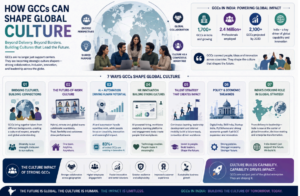
Organisations no longer
hire employees solely for technical expertise. They increasingly look for professionals who can
collaborate across cultures, adapt to change, solve complex business problems, and work
effectively in global teams. Continuous learning, leadership development, internal mobility, and
cross-functional collaboration have become essential parts of workforce planning. Companies
that invest in both technical and human skills create workforces capable of driving innovation
while strengthening employee trust and belonging.
Global enterprises increasingly trust their India-based teams to lead product development, AI
research, engineering excellence, customer experience, and enterprise transformation. As Indian
professionals take on larger leadership responsibilities, they are also influencing how
organisations approach collaboration, innovation, diversity, inclusion, and employee development.
The culture created inside India’s GCCs often spreads across global business units because
these centres work closely with teams around the world every day.
India has become one of the world’s most influential
centres for shaping the future of work. For HR startups, enterprise leaders, and multinational
organisations, the opportunity is clear. The companies that invest in building people-first, globally
connected cultures through their GCCs will be the ones that attract the best talent, drive
innovation, and achieve long-term business success.