

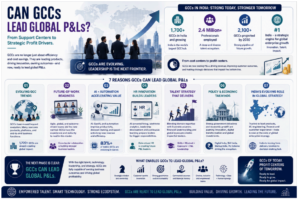
India has established itself as the world’s largest GCC destination, with more than 1,700 GCCs
employing approximately 2.4 million professionals across technology, engineering, finance,
cybersecurity, research, operations, and product development. Industry projections indicate that
India could host over 2,100 GCCs by 2030, supported by continued investment from
multinational enterprises. Many of these centres have already moved beyond execution and now
influence product strategy, customer experience, AI development, and enterprise transformation
Many India-based teams now own
complete product lifecycles, manage global engineering roadmaps, oversee digital transformation
programmes, and use advanced analytics to improve customer outcomes. When a GCC develops
products that generate revenue, improves customer retention, or identifies new business
opportunities, it begins contributing directly to enterprise financial performance rather than
simply supporting operations

Artificial Intelligence and automation are accelerating this transformation. Industry reports show
that over 83% of India’s GCCs are actively investing in Generative AI, integrating AI-assisted
software development, intelligent automation, predictive analytics, machine learning, and
advanced decision-support systems into everyday business processes. These technologies help
organisations improve productivity, reduce costs, accelerate product launches, and make more
informed strategic decisions.
Modern organisations operate through agile, cross-functional, and globally connected teams
rather than traditional hierarchical structures. Business leaders today must manage distributed
workforces, collaborate across multiple markets, and respond quickly to changing customer
needs. GCCs have been operating in this globally integrated environment for years, making them
well positioned to lead international teams and business functions.
Companies need leadership
development programmes, AI-powered talent intelligence, succession planning, workforce
analytics, executive coaching, and continuous learning platforms that develop commercial
thinking alongside functional expertise. HR startups have a major opportunity to build solutions
that help enterprises identify high-potential leaders, assess strategic decision-making
capabilities, and prepare professionals for global business leadership roles.
Senior executives based in India increasingly participate in global board discussions and
enterprise strategy. As organisations continue decentralising decision-making, it becomes more
likely that GCC leaders will take ownership of complete business units, including revenue
generation, profitability, investment planning, and long-term growth. The transition from
operational leadership to full P&L ownership is becoming a natural next step rather than an
ambitious possibility.
The future of GCCs will be defined by leadership as much as technology. With 1,700+ GCCs, 2.4
million highly skilled professionals, widespread AI adoption, modern HR innovation, forwardlooking talent strategies, and strong policy support, India has created an ecosystem capable of
producing global business leaders. For HR startups, enterprise leaders, and multinational
organisations, this represents a significant opportunity. The GCCs that invest in developing
commercial leadership, strategic thinking, and innovation-driven talent today will be well
positioned to lead not just global operations, but global P&Ls in the years ahead.