
The healthcare industry is going through a massive transformation, and Global Capability
Centers (GCCs) are quietly becoming one of its biggest growth drivers. While sectors like banking
and technology have already scaled their GCC models, healthcare GCCs still hold significant
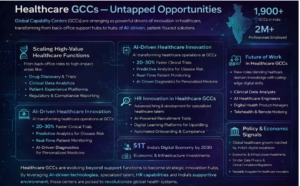
untapped potential. In India alone, there are 1,900+ GCCs employing over 2 million professionals,
and a growing number of these centers now belong to pharmaceutical, healthcare, and life
sciences companies.
Earlier, healthcare GCCs mainly handled back-office tasks such as billing, claims processing, and
basic IT support. Today, they are involved in drug discovery, clinical data analytics, regulatory
reporting, and patient experience platforms. With AI + automation technologies advancing
rapidly, healthcare GCCs can now automate 30–40% of repetitive administrative tasks, allowing
professionals to focus on research, innovation, and patient-centric solutions.
Professionals are now expected to combine domain knowledge in healthcare with digital skills
such as data analytics, AI, and cloud computing. For graduates entering this field, this creates
unique opportunities to work at the intersection of healthcare and technology. Roles such as
clinical data analysts, AI healthcare engineers, and digital health product managers are
becoming increasingly important.
From analyzing large volumes of clinical trial data to predicting disease patterns, AI is
transforming how healthcare organizations operate. GCCs in India are increasingly becoming
hubs for AI-driven healthcare innovation. For example, machine learning models can reduce
clinical trial timelines by 20–30%, while predictive analytics can improve patient outcomes by
identifying risks early.
Healthcare GCCs deal with highly specialized talent requirements, making hiring and retention
more complex. HR teams are using AI-powered recruitment tools to identify niche skill sets,
while digital learning platforms help upskill employees in emerging technologies. Automation is
also improving HR operations by streamlining onboarding, compliance documentation, and
workforce management.
The global healthcare industry is expected to grow significantly over the next decade, driven by
aging populations, rising healthcare costs, and increased focus on digital health solutions. India’s
digital economy, projected to reach $1 trillion by 2030, is also supporting this growth through
investments in technology infrastructure and innovation ecosystems.
Despite this progress, many opportunities remain untapped. Areas such as personalized
medicine, telehealth platforms, AI-driven diagnostics, and real-time patient monitoring are still
in early stages of adoption within GCC ecosystems. By investing in these areas, healthcare GCCs
can unlock new value streams and contribute to better patient outcomes globally.
In conclusion, healthcare GCCs represent one of the most promising yet underutilized
opportunities in the global enterprise landscape. By combining AI-driven innovation, strong talent
strategies, and forward-looking HR practices, organizations can transform these centers into
powerful engines of growth. As healthcare continues to evolve, GCCs in India are well-positioned
to lead the next wave of global innovation and impact.