

The critical need for real business insight is driven by rapidly expanding Global Capability Center
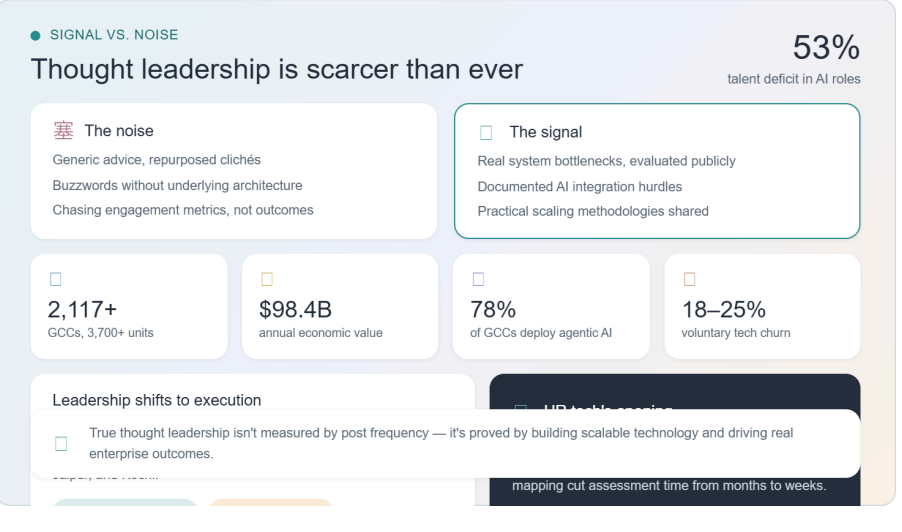
(GCC) trends. India currently hosts over 2,117 active GCCs operating across more than 3,700
distinct units, generating USD 98.4 billion in annual economic value and employing over 2.36
million skilled professionals. Crucially, over 90% of these centers operate as multi-functional
innovation hubs, where Indian engineering teams own end-to-end cloud platforms, global financial
risk engines, and critical IP. In boardrooms where executives manage multi-billion-dollar enterprise
budgets, superficial commentary holds no weight. Leaders demand individuals who understand
operational realities and can offer authentic, data-backed perspectives on navigating complex markets.
This dynamic is further highlighted by the rapid integration of AI and automation across business
infrastructure. Enterprise data reveals that over 78% of GCCs actively deploy Generative AI and
agentic workflows, while intense market competition has created a 53% talent deficit in
specialized AI roles. In an environment where voluntary tech churn averages 18% to 25%, selfproclaimed thought leaders often rely on buzzwords without understanding the underlying code or
architecture. Real thought leadership in technology emerges when professionals publicly evaluate realworld system bottlenecks, document complex AI integration hurdles, and share practical
methodologies for scaling digital infrastructure across global business units.

Addressing this gap requires forward-looking future-of-work thinking to reshape overall enterprise
talent strategy. Global organizations are recognizing that superficial employer branding initiatives do
not attract elite talent. Progressive leaders are replacing empty executive posturing with skill-first
development frameworks and establishing technical footprint expansions into emerging regional hubs
like Coimbatore, Jaipur, and Kochi. Operating in these secondary tech hubs allows companies to build
highly stable candidate pools while securing 10% to 15% lower attrition rates and 25% to 35% in
overall operational savings. In these high-growth nodes, effective leaders focus on tangible
execution, team building, and operational resilience rather than online self-promotion.
This shift creates a massive window for HR innovation, driving rapid market demand for agile B2B HR
startups. Legacy talent screening tools that evaluate candidates based on keyword density or
superficial social media metrics fail to identify genuine operational experts. High-growth HR tech
startups developing AI-driven candidate assessment engines, contribution-based portfolio evaluation
tools, automated skill-graph mapping, and predictive retention analytics are seeing rapid enterprise
adoption.These modern technologies enable recruitment teams to cut assessment timelines from
months down to weeks, allowing talent acquisition teams to separate real domain expertise from
artificial digital noise.
Strong policy and economic signals confirm that India’s evolving role in global enterprise
strategy relies on high-impact, authentic leadership. Accounting for nearly 2% of national GDP and
absorbing over 35% of commercial office real estate leasing nationwide, the GCC sector forms a
core pillar of the country’s economic momentum.True thought leadership is not measured by post
frequency or follower counts. It is proved by building scalable technology, fostering talent, and driving
meaningful enterprise outcomes on the global stage.