
As Generative AI tools saturate the professional landscape, creating polished content has become
practically instantaneous. Anyone can prompt a software model to draft a thought leadership article,
compose a viral social media update, or write a compelling professional summary within seconds.
However, as digital platforms overflow with AI-generated text, global executive boards and hiring teams
face a new challenge: distinguishing synthetic output from genuine human expertise. For university
graduates establishing their early careers and HR startups building modern talent platforms, this shift
presents a fundamental question.While AI can draft your posts, can it build an authentic professional
reputation?
The necessity of authentic reputation building is closely tied to current Global Capability Center
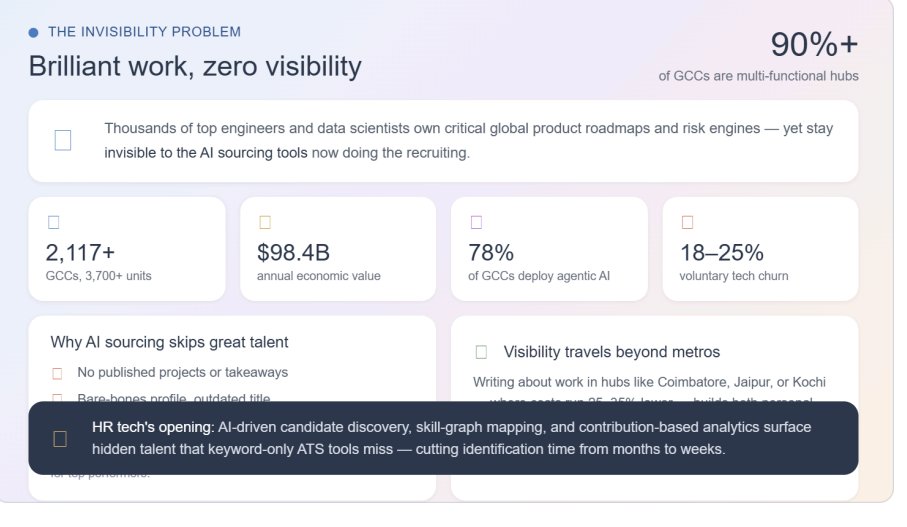
(GCC) trends. India currently hosts over 2,117 active GCCs operating across more than 3,700
distinct units, generating USD 98.4 billion in annual economic value and employing over 2.36
million skilled professionals. In an environment where global
leaders are hired to make high-stakes business decisions, reliance on generic, machine-generated
content actually dilutes personal authority.

This dynamic is further complicated by the massive integration of AI and automation across business
functions.Within the enterprise landscape, over 78% of GCCs actively deploy Generative AI and
agentic workflows, while demand for specialized machine learning talent has caused a 53% skill
deficit in niche technical roles. In this environment of extreme competition—where voluntary tech
churn averages 18% to 25%—relying on generic AI text makes a candidate blend into the background.
True technical reputation is built when professionals publicly break down proprietary engineering
challenges, analyze actual system failures, and share contextual insights that automated text
generators simply cannot replicate.
Addressing this challenge requires progressive future-of-work thinking to refine overall talent
strategy. Forward-thinking corporate leaders and ambitious professionals recognize that AI should be
used as an efficiency multiplier, not a replacement for original thought. Companies are actively
designing skill-first hiring programs and expanding technical footprints into regional hubs like
Coimbatore, Jaipur, and Kochi, where operational costs are 25% to 35% lower and attrition rates drop
by 10% to 15%. In these growing tech nodes, building a reputation anchored in local leadership, team
mentorship, and practical execution holds far more value than posting automated online updates.
This shift creates a massive window for HR innovation, driving demand for next-generation B2B HR
startups. Legacy recruitment systems that screen candidates based on keyword density are easily
gamed by AI-generated resumes and profiles. High-growth HR tech startups developing AI-driven
candidate assessment engines, contribution-based portfolio evaluation tools, automated skill-graph
mapping, and real-time candidate engagement dashboards are seeing immediate enterprise adoption.
These modern technologies enable recruitment teams to cut assessment timelines from months
down to weeks, allowing talent managers to identify true technical capability rather than superficial
digital noise.