

Captive cybersecurity centers in India, often known as Global Capability Centers (GCCs), are
becoming a key part of how global companies manage digital risk and security. As cyber
threats continue to grow in scale and complexity, organizations are no longer treating
cybersecurity as just an IT function. Instead, it has become a business-critical priority. India
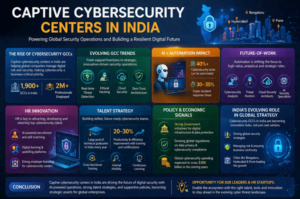
has emerged as a strong destination for these captive centers, with 1,900+ GCCs employing
over 2 million professionals.
One of the most important GCC trends in cybersecurity is the shift from traditional support
roles to strategic, innovation-driven functions. Earlier, captive centers mainly handled basic
monitoring, compliance checks, and incident reporting. Today, they are deeply involved in
advanced areas like real-time threat detection, ethical hacking, cloud security, and zero-trust
architecture.

The rise of AI + automation is transforming how these centers operate. Technologies such as
machine learning and automated threat detection systems are helping companies identify
and respond to cyber threats faster than ever before. For example, AI can detect unusual
patterns in network traffic and flag potential breaches in seconds. Studies suggest that over
40% of cybersecurity tasks can be automated, leading to 30–35% faster incident response
times.
Companies are now using AI-powered recruitment tools to identify candidates with niche
cybersecurity skills. Digital learning platforms are helping employees upskill in areas like
ethical hacking, cloud security, and data privacy. HR teams are also focusing on building
strong employer brands by emphasizing cybersecurity as a meaningful and high-impact
career path.
India produces a large pool of technical graduates every year, but companies need
professionals who can combine technical knowledge with security expertise. Organizations
that invest in structured training programs and certifications often see 20–30% improvement
in productivity and efficiency. Cross-functional training, internal mobility, and continuous
learning are becoming key elements of talent development strategies in cybersecurity GCCs
With increasing regulations around data privacy and cybersecurity compliance globally,
companies are under pressure to adopt stronger security measures. This is driving higher
investments in cybersecurity capabilities, with global spending expected to cross $300
billion in the coming years. These factors make India an attractive location for expanding
captive cybersecurity operations.
Many
multinational companies are setting up or expanding their cybersecurity GCCs in cities like
Bengaluru, Hyderabad, and Pune. These centers are no longer just cost-saving units; they are
becoming innovation hubs that drive global security strategies. They help organizations
manage risks, protect data, and ensure business continuity on a global scale.
In conclusion, captive cybersecurity centers in India are playing a vital role in shaping the
future of digital security. With strong AI-driven capabilities, evolving talent strategies, and
supportive policy frameworks, these centers are moving beyond support functions to
become strategic assets.