

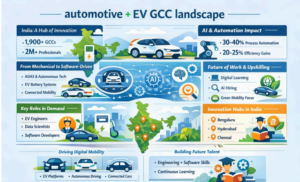
One of the most notable GCC trends in the automotive and EV space is the transition from
traditional mechanical engineering support to software-driven innovation. Earlier, GCCs
mainly focused on design support, testing, and back-end operations. Today, they are deeply
involved in developing advanced driver-assistance systems (ADAS), autonomous driving
technologies, EV battery management systems, and connected car platforms.
Technologies such as machine learning, computer vision, and predictive analytics are being
used to improve vehicle safety, optimize manufacturing processes, and enhance user
experience. In manufacturing, automation is improving efficiency and reducing defects.
Studies suggest that 30–40% of automotive processes can be automated, leading to 20–25%
improvements in operational efficiency.
As the industry becomes more technology-focused, there is a growing demand for
professionals who understand both engineering and software. Roles such as EV engineers,
embedded systems developers, data scientists, and mobility software architects are
becoming critical. For graduates, this creates exciting opportunities to work at the
intersection of mobility, sustainability, and technology, but it also requires continuous
learning and upskilling.
Companies are leveraging AI-powered hiring platforms to identify talent with niche skills in EV
technologies, software development, and data analytics. Digital learning platforms are
helping employees upgrade their skills in areas like battery technology, autonomous systems,
and connected mobility. HR teams are also focusing on building strong employer branding
around sustainability and innovation, as many young professionals are attracted to
companies working on future mobility solutions.
Organizations that invest in structured training programs and certifications can achieve 20–
30% higher productivity and faster project delivery. Cross-functional training, internal
mobility, and collaboration between hardware and software teams are becoming key
strategies to build future-ready talent.
Many multinational companies are setting up or expanding their GCCs in cities like Bengaluru,
Hyderabad, Chennai, and Pune to leverage India’s strong talent pool and cost advantages.
These centers are no longer just support units; they are becoming innovation hubs that drive
global product development and digital transformation.
India has set ambitious targets to increase EV penetration and reduce carbon emissions,
creating strong demand for innovation in this space. Globally, automotive companies are
investing billions of dollars in EV and autonomous technologies, with EV sales expected to
account for over 30% of total vehicle sales by 2030. These trends are driving the expansion
of automotive GCCs in India
In conclusion, the automotive and EV GCC landscape reflects a broader shift toward
technology-driven and sustainable growth. With strong AI-powered capabilities, evolving
talent strategies, and supportive policy frameworks, GCCs in India are becoming central to
the global mobility transformation.