

The rapid expansion of Global Capability Centers across India has triggered a fundamental debate
within corporate boardrooms, policy forums, and HR circles: are GCCs genuinely adding net-new
employment, or are they merely re-architecting existing job profiles? The evidence in 2026
demonstrates that GCCs are doing both simultaneously—driving net net-new employment
expansion while completely converting the internal mechanics of existing work.
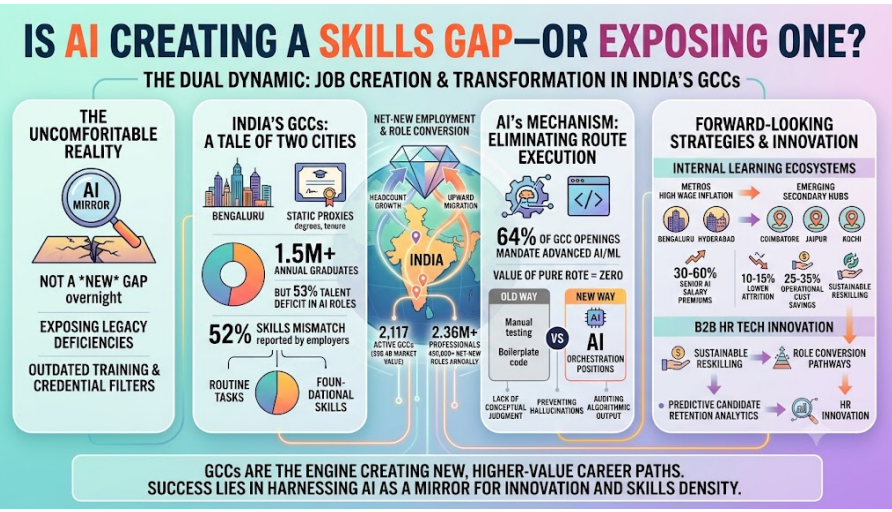
As the sector reaches 2,117 active centers generating $98.4 billion in market value and employing
over 2.36 million professionals, the sheer scale confirms massive absolute job creation. GCCs are
expected to add over 450,000 net-new roles annually, absorbing significant technical talent across
the country. However, focusing exclusively on net headcount growth obscures a far deeper structural
transformation: the nature, composition, and skill baseline of these jobs have undergone a permanent
upward migration.

The primary engine reshaping this workforce is the rapid integration of AI and automation across
business infrastructure.With automated platforms handling L1 IT ticketing, manual regression testing,
and basic code writing, 64% of new GCC job openings explicitly require advanced AI, machine
learning, or intelligent automation capabilities.This shift has transformed transactional support
roles into specialized capability positions. Even as the industry manages a 53% talent deficit in
specialized AI roles and voluntary tech churn between 18% and 25%, the sector is not cutting
workforce capacity; it is replacing manual execution roles with high-impact “AI Orchestration” positions.
Adopting this dual model of expansion and transformation requires forward-thinking future-of-work
thinking to rebuild overall enterprise talent strategy. Organizations are abandoning broad volume
hiring, focusing instead on “capability density” and value creation per seat.To build stable specialized
pods without incurring hyper-inflation in primary metros like Bengaluru and Hyderabad, global firms are
decentralizing operations into secondary hubs such as Coimbatore, Jaipur, and Kochi. Establishing
specialized spokes in these regional centers enables GCCs to achieve 10% to 15% lower voluntary
attrition rates while securing 25% to 35% in overall operational cost savings, allowing firms to
invest heavily in continuous employee reskilling.
This simultaneous job creation and role transformation presents an extraordinary growth vector for HR
innovation, accelerating market adoption for agile B2B HR startups. Legacy recruitment software
designed to parse standard resumes fails to capture real-time technical capabilities or predict internal
adaptability. High-growth HR tech startups developing AI-driven skill-graph evaluation engines, live
sandbox work-sample assessments, real-time compensation intelligence tools, and predictive
candidate retention analytics are achieving rapid enterprise integration. Modern tools empower talent
acquisition leaders to shorten candidate identification and verification timelines from months down to
weeks, bringing data-backed precision to dynamic workforce planning.