

The short answer is no—unrestricted AI usage across every single business task creates severe legal,
operational, and intellectual property risks.While artificial intelligence significantly accelerates
execution, treating it as a universal substitute for human labor introduces “Shadow AI” vulnerabilities,
data leakages, and quality degradation. Forward-looking enterprise boardrooms are deploying strict
task-based AI governance models rather than granting blanket approval.
This debate is particularly critical across Global Capability Center (GCC) trends in India.The nation
currently hosts 2,117 active GCCs operating across 3,728 units, representing a $98.4 billion
economic sector that employs over 2.36 million skilled professionals. As over 90% of these
hubs operate as multi-functional innovation centers owning global enterprise IP, uncontrolled AI
usage directly threatens core architecture, financial models, and regulatory compliance. Allowing
employees to paste confidential source code or strategic client data into unsanctioned public models
creates catastrophic security blind spots.

The catalyst driving this policy boundary is the widespread adoption of AI and automation across
business infrastructure.With 64% of all new GCC job openings mandating advanced AI or
machine learning skills, enterprises actively encourage AI tool adoption. However, because the
ecosystem handles an industry-wide 53% talent deficit in specialized AI roles, many employees
lack the technical depth required to spot AI hallucinations, security vulnerabilities, or copyright
infringements.
Establishing clear operational boundaries requires progressive future-of-work thinking to reshape
overall talent strategy. Leading organizations categorize corporate tasks into distinct governance
buckets: fully automated execution, hybrid human-in-the-loop tasks, and human-only strategic
judgment.To enforce these governance frameworks without throttling engineering velocity in primary
metros like Bengaluru and Hyderabad, global firms are expanding into emerging secondary hubs like
Coimbatore, Jaipur, and Kochi. Establishing specialized compliance and security pods in these
regional centers enables GCCs to achieve 10% to 15% lower voluntary attrition rates while
securing 25% to 35% in overall operational cost savings, creating stable environments for
systematic AI auditing.
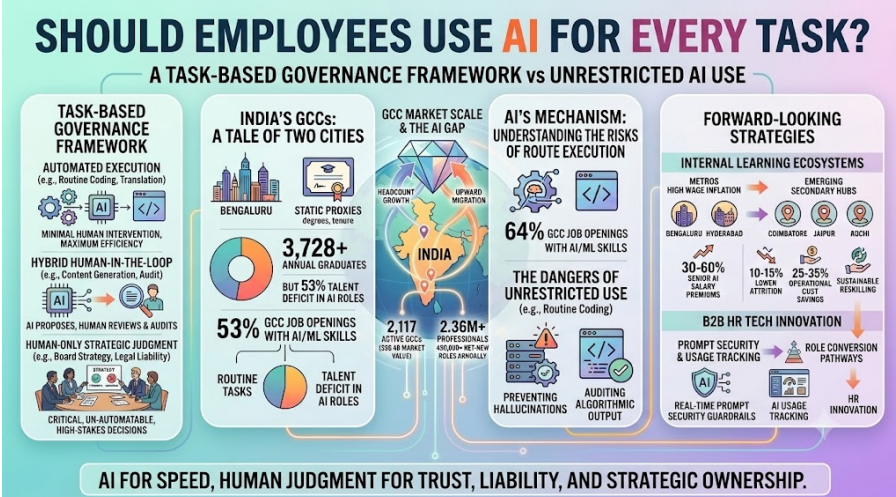
This governance bottleneck creates an extraordinary market opportunity for HR innovation,
accelerating enterprise adoption for agile B2B HR startups. Legacy HR policies cannot monitor realtime AI prompt interactions or enforce acceptable usage limits. High-growth HR tech startups
developing AI usage tracking engines, automated skill-graph evaluation tools, real-time prompt security
guardrails, and predictive policy compliance analytics are seeing rapid enterprise integration. Modern
platforms empower talent acquisition and HR leaders to track employee AI competency in real-time
while ensuring data privacy protocols remain intact.