

For decades, ambitious
professionals were told that acquiring deep technical domain expertise—what you know—was the sole
prerequisite for career longevity.Today, however, algorithms can synthesize complex code, analyze
market data, and generate technical summaries instantly. In an environment where baseline knowledge
is widely accessible, executive boards and hiring teams face a new challenge: separating true strategic
capability from digital noise. For university graduates entering the workforce and B2B leaders designing
modern talent platforms, a critical dilemma defines this era: does raw technical skill hold more value, or
has discoverability become the ultimate professional advantage?
The answer lies in the massive evolution of Global Capability Center (GCC) trends across the
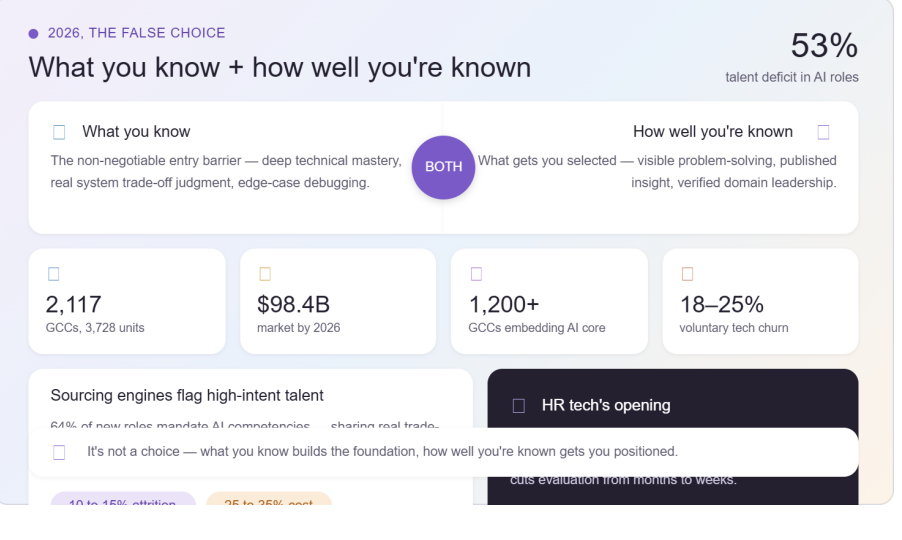
country. In 2026, India hosts 2,117 active GCCs operating across 3,728 units, representing an
unprecedented $98.4 billion economic market that employs over 2.36 million skilled
professionals. Crucially, over 90% of these capability hubs now operate as multi-functional
innovation centers, taking direct ownership of global cloud architectures, AI governance models, and
enterprise P&L mandates. In an ecosystem managing high-stakes international mandates, what you
know remains the non-negotiable entry barrier.

This dynamic is further accelerated by the deep integration of AI and automation across candidate
discovery systems. More than 1,200 capability centers now embed AI/ML capabilities into their
core functions, while 64% of all new GCC openings mandate advanced AI competencies.
However, an industry-wide 53% talent deficit in specialized AI roles has pushed voluntary tech
churn up to 18% to 25%. In a market where recruiters deploy intelligent sourcing tools to continuously
crawl public web ecosystems, professionals who keep their expertise locked behind silent execution
remain invisible.
Adapting to this landscape requires progressive future-of-work thinking to reshape overall enterprise
talent strategy. Corporate leaders recognize that hiring talent based solely on passive resumes or
inflated social media personas leads to costly mishires. Companies are establishing skill-first
evaluation frameworks and expanding engineering footprints into emerging Tier-2 technology hubs like
Coimbatore, Jaipur, and Kochi. Operating in these expanding regional nodes allows organizations to
tap into stable candidate pools while securing 10% to 15% lower attrition rates and 25% to 35% in
overall operational cost savings.
This shift presents an extraordinary window for HR innovation, driving rapid enterprise demand for
agile B2B HR startups. Legacy applicant tracking platforms that filter candidates based on keyword
density fail to evaluate authentic technical capability or predict candidate joining intent. High-growth HR
tech startups developing AI-driven candidate assessment engines, real-time compensation intelligence
tools, contribution-based portfolio mapping, and predictive retention analytics are achieving rapid
enterprise adoption. Modern HR platforms empower talent acquisition managers to cut candidate
evaluation timelines from months down to weeks, enabling recruitment teams to cut through
synthetic digital noise and identify candidates with both verified technical depth and strong professional
discoverability.