

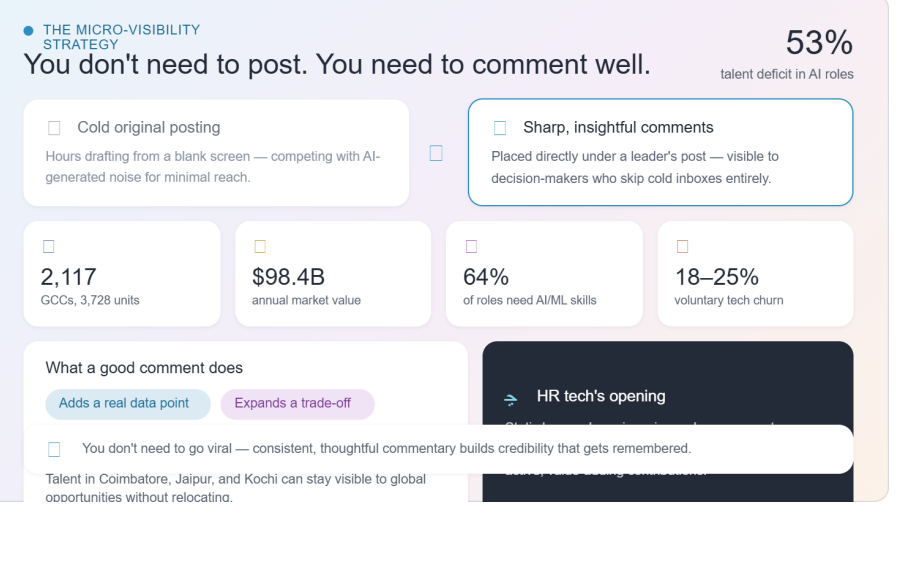
India currently hosts 2,117 active GCCs operating across 3,728 distinct
units, generating $98.4 billion in annual market value and employing over 2.36 million skilled
professionals. Crucially, over 90% of these centers operate as multi-functional innovation hubs
where Indian engineering leads take direct global ownership of core cloud platforms, complex risk
architectures, and global enterprise IP.When global leaders post about enterprise transformation or
system design, leaving a sharp, insightful comment underneath their post places your domain expertise
directly in front of executive decision-makers who rarely browse cold inboxes or unrequested resume
submissions.

The rise of AI and automation across talent acquisition makes this micro-visibility strategy even more
critical.With 64% of all new GCC job openings mandating advanced AI, machine learning, or
intelligent automation capabilities, demand for specialized engineers has created a 53% talent
deficit in AI roles, driving voluntary tech churn rates to 18% to 25%. In a market where recruiters and
hiring managers are actively searching for niche problem-solving capabilities, an insightful comment
that expands on an architectural trade-off or breaks down an edge-case debugging challenge serves
as an instant trust signal. It shows that you possess practical experience, critical thinking, and the ability
to articulate technical concepts effectively.
Capitalizing on this approach requires forward-looking future-of-work thinking to reshape personal
and organizational talent strategy. Instead of viewing social platforms as broadcasting channels,
progressive professionals treat them as collaborative industry forums. By consistently adding value to
high-level discussions—asking sharp questions, offering real-world data points, or respectfully
expanding on complex ideas—you build meaningful relationships over time. Furthermore, as global
companies expand their footprints into regional tech hubs like Coimbatore, Jaipur, and Kochi—where
operational costs are 25% to 35% lower and attrition drops by 10% to 15%—engaging in digital
commentary allows talent in secondary cities to stay closely connected to global enterprise
opportunities without physical relocation.
This shift creates a major window for HR innovation, accelerating demand for agile B2B HR startups.
Legacy applicant tracking platforms that rely on static keyword queries fail to evaluate authentic
candidate engagement or domain authority. High-growth HR tech startups developing AI-driven
candidate discovery engines, contribution-based portfolio mapping, real-time compensation
intelligence tools, and predictive retention analytics are seeing rapid enterprise adoption. Modern
recruitment platforms empower talent acquisition managers to cut candidate identification timelines
from months down to weeks, bringing data-backed precision to talent pipelines by locating highcaliber professionals through their active, value-adding digital contributions.