

For decades, entering the corporate world with a solid degree and a strong work ethic was enough to
guarantee a stable, upwardly mobile career.Today, across the hyper-competitive global technology
landscape, merely executing your daily tasks is the bare minimum. For recent graduates navigating
their first major career moves and B2B professionals scaling enterprise teams, the definition of
professional value has fundamentally changed. As automated tools take over routine execution,
companies no longer pay a premium for people who just do their jobs well. Instead, global businesses
are actively hunting for dynamic leaders who offer strategic foresight, cross-functional adaptability, and
a highly visible personal brand that proves their deep domain expertise.
This escalating expectation is directly tied to the massive acceleration of Global Capability Center
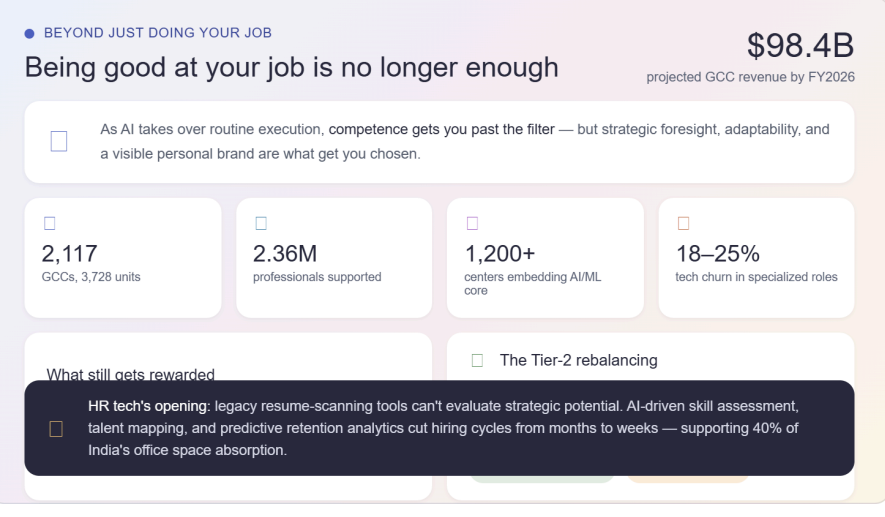
(GCC) trends across the country. India currently hosts 2,117 active GCCs operating across 3,728
units, forming an ecosystem that supports approximately 2.36 million professionals. Generating an
incredible $98.4 billion in projected market revenue by FY2026, these centers have moved far
beyond traditional back-office support.Today, they act as the central nerve centers for multinational
corporations.This dramatic transformation highlights India’s evolving role in global enterprise
strategy, as Indian talent increasingly takes direct ownership of global products, platforms, and
overarching business outcomes.

The rapid integration of AI and automation is the primary catalyst rendering basic competence
obsolete. Industry data reveals that nearly half of all capability centers established since 2021 focused
on artificial intelligence from their very inception, with over 1,200 centers now embedding AI/ML
capabilities into their core functions. As generative AI engines seamlessly write code, analyze data,
and generate reports, the demand for specialized human insight has skyrocketed.This technological
shift has triggered intense market competition, driving voluntary tech churn rates up to 18% to 25% for
highly specialized roles.When algorithms can handle standard execution, your professional survival
depends on mastering autonomous workflows, interpreting complex risk models, and solving
ambiguous architectural challenges that machines cannot comprehend.
Global organizations are shifting away
from linear headcount growth and instead prioritizing AI-led productivity and aggressive internal
reskilling. As part of this strategic realignment, companies are actively expanding their footprints into
emerging Tier-2 technology hubs such as Coimbatore, Jaipur, and Kochi. By tapping into these
regional talent ecosystems, organizations can achieve 10% to 15% lower attrition rates and secure
25% to 35% in overall operational cost savings. Operating in these distributed, high-efficiency
models requires professionals to act as proactive business partners rather than passive task executors.