
In today’s hyper-connected professional ecosystem, your LinkedIn profile serves as your digital front
door, but an unoptimized profile can silently sabotage your career progression. For university graduates
entering the job market and enterprise leaders building high-performing teams, reliance on a static,
digital resume is no longer enough to stand out. Modern talent acquisition relies heavily on algorithmic
candidate discovery, automated skill-mapping, and real-time candidate engagement.When your profile
lacks clear domain alignment, documented problem-solving frameworks, or visible project ownership,
automated recruitment software overlooks your profile long before a human hiring manager ever
reviews it.
This visibility gap is deeply tied to rapidly evolving Global Capability Center (GCC) trends across
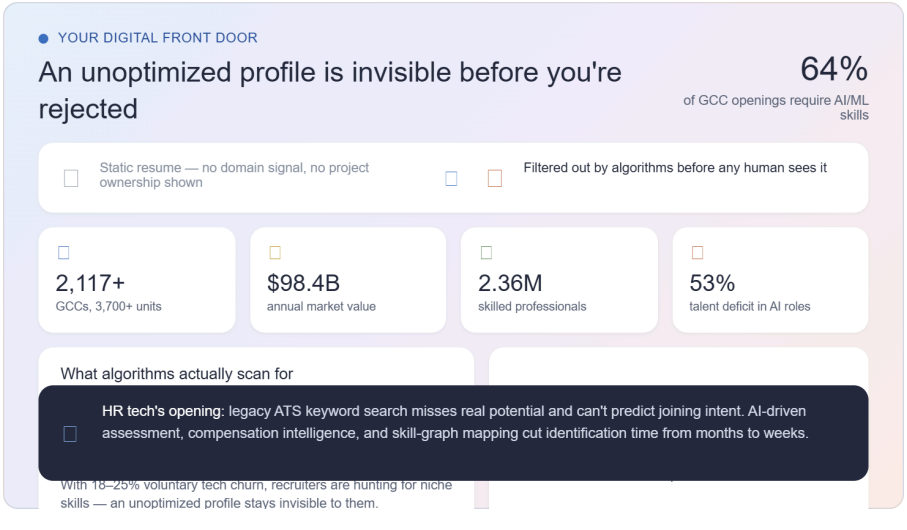
India.The country currently hosts 2,117 active GCCs operating across more than 3,700 distinct
units, generating $98.4 billion in annual market value and employing over 2.36 million skilled
professionals.With over 90% of these capability hubs operating as multi-functional innovation
centers, global enterprises are actively scouting for leaders who can own end-to-end cloud platforms,
manage AI infrastructure, and direct enterprise software architecture. As global firms build out strategic
innovation centers, a generic LinkedIn profile fails to reflect the high-level technical capability that
enterprise boardrooms actively seek.

This dynamic is further complicated by the rapid adoption of AI and automation in talent acquisition.
Modern recruitment stacks use sophisticated algorithms to scan public web ecosystems, evaluating
candidates based on skill graphs, public code repositories, and engagement signals.With 64% of all
new GCC job openings explicitly requiring advanced AI or machine learning skills, demand for
specialized engineers has created a 53% talent deficit in AI roles, driving voluntary tech churn rates
up to 18% to 25%. In a market where recruiters are desperately searching for niche skills, an
unoptimized profile means you remain completely invisible to top-tier enterprise opportunities.
Navigating this competitive market requires forward-looking future-of-work thinking to reshape
personal and organizational talent strategy. Professionals can no longer afford to treat their digital
presence as a passive resume. Instead, progressive engineers and managers operate as visible
thought leaders, regularly publishing technical insights, showcasing complex project outcomes, and
demonstrating continuous skill development. Furthermore, as enterprises expand into regional
technology hubs like Coimbatore, Jaipur, and Kochi—where operational costs are 25% to 35% lower
and attrition drops by 10% to 15%—a strong digital brand unlocks high-value leadership opportunities
regardless of your geographic location.
This shift creates an extraordinary window for HR innovation, accelerating demand for specialized
B2B HR startups. Legacy applicant tracking platforms and manual keyword searches fail to capture
authentic candidate potential or predict joining intent in a multi-offer market. High-growth HR tech
startups developing AI-driven candidate assessment engines, real-time compensation intelligence
tools, automated skill-graph mapping, and predictive candidate retention analytics are seeing rapid
enterprise adoption. Modern recruitment platforms enable hiring teams to cut candidate identification
timelines from months down to weeks, helping organizations locate hidden, high-caliber talent that
standard search parameters miss.