

Central economic signals—such as raising the transfer pricing safe harbour
eligibility ceiling from ₹300 crore to ₹2,000 crore at a uniform 15.5% margin—have drastically
reduced tax friction and audit risk for foreign firms. Complemented by national framework guidelines,
state governments across India are actively competing to offer lucrative financial mechanisms, making
government incentives a central calculation in global expansion plans.
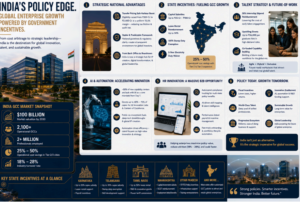
The rapid evolution of Global Capability Center trends is closely tied to these policy frameworks. As
India’s GCC market expands toward a $100 billion valuation by 2030 with over 2,100 operational
centers, state governments are deploying aggressive fiscal measures to capture new investments.
Specialized GCC policies offer capital subsidies of up to ₹25 crore to ₹100 crore, lease rental
reimbursements up to 50%, full stamp duty exemptions, and 5-year electricity duty waivers.
Furthermore, state programs incentivizing expansion into tier-two and tier-three hubs are enabling
enterprises to achieve 25% to 50% operational cost savings while unlocking fresh regional talent
corridors.

Rather than relying solely on private training programs, progressive state policies directly fund
workforce capability building. Frameworks now offer 50% internship stipend reimbursements
alongside upskilling grants covering up to ₹36,000 per graduate hire in high-demand technical roles.
By co-funding talent development, policy-makers enable businesses to transition seamlessly into agile,
hybrid operating models and build homegrown talent pipelines directly aligned with global business
requirements.
The integration of artificial intelligence and enterprise automation is accelerated by these policy
dynamics. Nearly half of all new capability centers established in recent years are built with AI
as a core mandate from inception.To foster deep-tech breakthroughs, state frameworks provide
dedicated grants covering up to 40% to 75% of capital expenditure for setting up AI Innovation
Labs and Centers of Excellence. Supported by public co-investments, enterprise hubs are
delegating routine execution to automated workflows while positioning their Indian centers to lead
complex generative AI development, cloud architecture, and global governance frameworks.
Expanding enterprise centers face complex operational demands, including
managing rapid headcount growth, navigating multi-state compliance rules, and claiming performancelinked payroll incentives. High market competition and industry turnover rates hovering between 18%
and 28% mean enterprise leaders desperately need automated tools. HR startups that deliver
automated compliance tracking, AI-driven skill mapping, talent analytics, and fast-track onboarding
solutions are finding immediate B2B traction among global centers looking to capture maximum policy
value.
Government incentives have shifted from simple tax relief into active catalysts for enterprise innovation
and sustained corporate growth. By combining world-class technical talent with fiscal subsidies,
progressive regulatory environments, and cutting-edge HR innovation, India offers an unparalleled
foundation for international business. For executive decision-makers, HR tech founders, and enterprise
strategists, understanding and leveraging these government incentives is essential for building
scalable, high-impact operations on the global stage