

India’s position in global business has shifted from back-office support to high-impact strategic
leadership. At the heart of this transformation is Pune, a city rapidly establishing itself as a premier
innovation hub. Long recognized as an academic power and industrial engine, Pune is now capturing
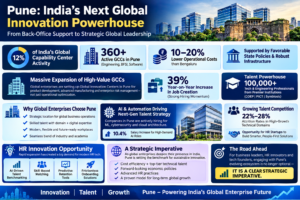
12% of India’s Global Capability Center activity and hosting over 360 active GCCs across
engineering, BFSI, and software domains.This economic momentum is supported by favorable state
policies, robust infrastructure, and operational costs that remain 10% to 20% lower than Bengaluru,
making the city an ideal destination for international enterprises.
The defining catalyst behind Pune’s growth is the massive expansion of high-value Global Capability
Centers. Global giants are no longer coming to Pune simply to optimize operational budgets; they are
establishing dedicated Global Innovation Centers focused on complex product development, advanced
manufacturing, and enterprise risk management. Local hiring data highlights this shift, showing an
extraordinary 39% year-on-year increase in job creation alongside steady expansion from both
existing operators and new enterprise entrants.This momentum signals a mature market where
multinational organizations are comfortable scaling long-term global functions.

Unlike tech hubs focused purely on software apps, Pune’s talent pool seamlessly combines
mechanical domain expertise with modern cloud and data architectures.Thanks to elite institutions like
COEP, PICT, and Symbiosis, the city supplies a steady stream of over 100,000 tech and engineering
professionals to the local ecosystem.To retain this talent, modern workplaces across the Pune
Metropolitan Region are adopting hybrid operating models, flexible mobility policies, and continuous
upskilling initiatives that cater directly to graduate career expectations
The integration of artificial intelligence and automation has redefined local talent strategy. Companies
operating in the region are actively competing for specialized skills in machine learning, cybersecurity,
and cloud architecture, with market data showing salary increases of 10.4% and premium
compensation packages for high-demand AI roles. Rather than replacing human capital, automation
is pushing local teams toward strategic problem-solving and proprietary innovation. As a result,
businesses must continuously align their workforce capabilities with rapidly shifting enterprise
demands.
This hyper-growth environment presents a massive market opportunity for HR startups and modern HR
tech providers. Rapid expansion has created structural talent competition, with some high-growth
technical domains experiencing attrition rates between 22% and 28%.To solve this, human
resources leadership in Pune is replacing legacy recruiting methods with automated talent
benchmarking, skill-based matching, and AI-driven engagement platforms. HR startups that deliver
smart workforce analytics, predictive retention tools, and frictionless onboarding solutions are finding
an eager B2B audience among expanding enterprise centers.