

The expectations gap is most visible in how career progression is structured inside GCCs. The
original model was linear and relatively predictable — join as a junior professional, move through
well-defined technical grades, and progress steadily toward a senior individual contributor or
people management role. That structure made sense when GCC work was primarily about
executing defined processes with high consistency.
Professionals in high-demand roles are not asking for faster promotions on the old ladder — they
are asking for a different ladder entirely. One that recognises the breadth of their contribution,
the speed of their skill development, and the global significance of the work they are doing. GCCs
that do not redesign their career architecture for this new reality are building beautiful talent
pipelines that empty themselves into competitors who have.

The compensation expectation reset is equally urgent. Senior technology and AI professionals
in India’s top GCCs are now earning between ₹40 to ₹80 lakhs per annum at the five-to-eight
year experience level, with total compensation packages significantly higher when equity and
performance incentives are included. These numbers reflect a market where Indian professionals
are competing globally — where a talented AI engineer in Bangalore is aware that their skills are
valued in dollars and pounds, not just rupees.
GCC compensation frameworks that were designed for a world where India was primarily a costreduction play are systematically undervaluing the talent they depend on. Annual attrition in
high-skill GCC roles runs at 18 to 22 percent — and pay misalignment is consistently among the
top three reasons people leave. Resetting compensation expectations is not a cost problem. It is
a retention investment with a measurable return.
The cultural expectation reset may be the most complex but also the most consequential of the
three. Many GCCs still operate with a cultural architecture that was designed for a support
function — one that values process adherence, escalation protocols, and deference to global
headquarters over independent judgment, experimentation, and strategic initiative. The
professionals that GCCs need most urgently — AI researchers, product managers, risk architects,
and enterprise innovation leaders — do not thrive in that culture.
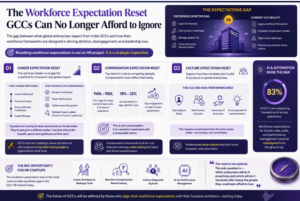
Building a culture that gives India-based teams genuine psychological safety, real decisionmaking authority, and meaningful ownership of outcomes requires deliberate investment from
the most senior levels of the organisation. It cannot be delegated to a culture committee or
addressed through an employee engagement survey. AI and automation are adding another layer
to this reset requirement. As over 83 percent of GCCs deploy Generative AI across their
operations, the workforce expectations around what human professionals are responsible for —
and how their performance is measured — need to be redesigned from the ground up
Enterprises need career architecture redesign
tools, real-time compensation benchmarking platforms, culture diagnostic systems, and AIera performance management frameworks that are calibrated to the strategic reality of
modern GCC operations. The organisations that help GCCs make this reset — thoroughly,
intelligently, and with genuine India context — will be building the most important and most
durable relationships in the GCC talent ecosystem