

For decades, headquarters made most
strategic decisions while teams in other countries focused on execution and support. Today, that
model is being replaced by a more decentralized enterprise where leadership, innovation, and
decision-making are distributed across multiple locations. At the heart of this transformation are
Global Capability Centers (GCCs), particularly those in India. No longer viewed as operational
support hubs, India’s GCCs are becoming the nerve centers of global enterprises—connecting
people, technology, data, and business strategy in real time.
The rise of decentralized enterprises reflects a broader GCC trend. Instead of relying on one
headquarters to manage every function, companies are distributing ownership across specialised
global centers. An engineering team in Bengaluru may lead product development, a finance team
in Hyderabad may manage global financial planning, while an AI center in Pune develops
enterprise-wide automation platforms.

GCCs generated approximately $64.6 billion in revenue in 2024, making India one of the world’s
largest and fastest-growing enterprise ecosystems. What makes these centers valuable today is
not simply their scale, but their ability to make strategic decisions, solve complex business
challenges, and lead global transformation programs from India.
Today, over 83% of India’s
GCCs are investing in Generative AI, integrating intelligent automation into software engineering,
customer experience, finance, compliance, cybersecurity, and business operations. AI enables
teams across different countries to collaborate using shared data, real-time insights, and
predictive analytics. Routine tasks are increasingly automated, allowing professionals to focus on
innovation, strategic thinking, customer experience, and business growth.
Modern organisations are no longer
structured around rigid departments or fixed hierarchies. Instead, they rely on cross-functional
teams that bring together engineers, designers, HR professionals, analysts, product managers, and
business leaders to solve problems collaboratively. Employees are expected to work across time
zones, cultures, and business functions while continuously learning new skills. Adaptability, digital
literacy, communication, and critical thinking have become essential capabilities for professionals
working inside today’s GCCs.
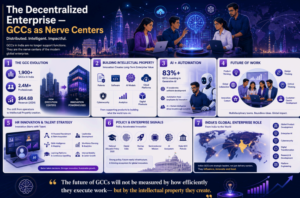
Many multinational organisations now trust their Indian GCCs to lead global product development,
enterprise AI initiatives, cybersecurity operations, financial transformation, sustainability
programs, and innovation strategies. Rather than simply supporting headquarters, Indian teams
increasingly influence strategic decisions that shape worldwide business outcomes.
The decentralized enterprise is not a future concept—it is already becoming the standard
operating model for global organisations. As businesses continue investing in AI, digital
transformation, and distributed leadership, GCCs will play an even greater role in connecting
global operations, accelerating innovation, and driving business resilience. With its world-class
talent, expanding GCC ecosystem, supportive government policies, and growing leadership
capabilities, India is uniquely positioned to become the nerve center of the modern global
enterprise.