

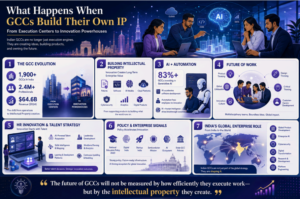
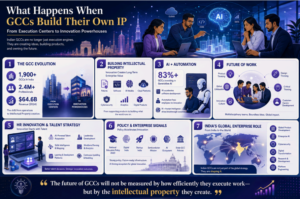
India’s GCC ecosystem has reached a scale where innovation is no longer optional—it has
become a business necessity. The country is home to over 1,900 GCCs, employing more than 2.4
million professionals and contributing approximately $64.6 billion in annual revenue. Intellectual Property has become one of the
clearest indicators of this evolution because it creates long-term competitive advantage instead
of short-term operational efficiency.
Building IP changes the role of a GCC completely. Rather than measuring success through cost
savings or process efficiency, organisations begin evaluating their India centres based on
innovation, product ownership, research capability, and business impact. Engineers are designing
new platforms, analysts are creating predictive models, cybersecurity teams are developing
proprietary security solutions, and product managers are influencing global product roadmaps.
Technical expertise remains essential, but employers are
placing equal importance on adaptability, design thinking, business understanding, and
customer-centric innovation. As GCCs take ownership of intellectual property, multidisciplinary
teams become the norm. Developers work alongside data scientists, HR leaders collaborate with
product managers, and business analysts partner with AI specialists to create solutions that
serve global markets.
The shift towards IP creation is transforming talent strategy as well. Companies can no longer rely
only on hiring experienced professionals. They must continuously develop internal capabilities
through learning, leadership development, and cross-functional exposure. Employees need
opportunities to work on innovation projects, contribute to research initiatives, and build skills
beyond their immediate roles. Organisations that invest in continuous learning are far more likely
to create breakthrough products than those focused only on operational performance.
. Companies need recruitment platforms that identify
creativity alongside technical ability, learning systems that support continuous upskilling, and
workforce analytics that measure innovation capability instead of only productivity. AI-powered
hiring tools, internal talent marketplaces, personalised learning platforms, and skills intelligence
solutions are becoming critical as enterprises compete for highly specialised talent. HR
innovation is therefore becoming a direct contributor to enterprise innovation.
Many multinational companies now trust their Indian GCCs with end-to-end ownership of global
products, enterprise platforms, AI solutions, cybersecurity initiatives, and digital transformation
programs. Instead of functioning as execution centres, GCCs are becoming strategic partners
that influence business direction, accelerate innovation, and create intellectual assets with
worldwide commercial value. This change strengthens India’s reputation as a destination for
knowledge creation rather than knowledge execution.
The future of India’s GCC ecosystem will increasingly be defined by the Intellectual Property it
creates. Cost efficiency may have attracted global enterprises to India, but innovation will
determine why they continue investing here.As more GCCs begin creating proprietary technologies instead of simply supporting
them, India is establishing itself as one of the world’s most important centres for enterprise
innovation.