

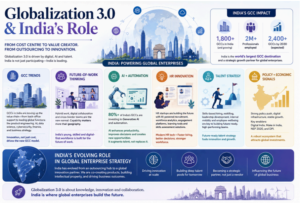
India is now home to over 1,800 GCCs, employing more than 2 million professionals, making
it the world’s largest GCC destination. These centres are no longer limited to handling backoffice operations. They are leading global functions such as product engineering, financial
planning, cybersecurity, data science, AI research, customer experience, and business
strategy. Many multinational companies now rely on their India GCCs to drive innovation
rather than simply reduce costs. This evolution reflects how India has become an essential
contributor to business growth across global markets.

One of the biggest drivers behind Globalization 3.0 is the changing nature of work. Hybrid
workplaces, digital collaboration, and cross-border teams have made geography far less
important than capability. Organisations now build global teams that work seamlessly across
different countries and time zones. India has become a preferred destination because of its
large talent pool, strong technology ecosystem, and growing expertise in emerging fields.
With one of the world’s youngest workforces, India is expected to remain a major source of
skilled professionals for decades to come.
Artificial Intelligence and automation are accelerating this transformation even further.
According to industry reports, more than 80% of India’s GCCs are actively investing in
Generative AI and automation technologies. AI is helping enterprises automate repetitive
work, improve customer experiences, strengthen decision-making, and increase operational
efficiency. However, AI is not replacing human talent—it is changing the type of skills
businesses need.
This shift has also created new opportunities for HR innovation. Traditional recruitment
models are no longer enough for organisations competing for specialised talent. HR startups
are building AI-powered recruitment platforms, employee engagement solutions, workforce
analytics tools, learning management systems, and skills assessment platforms to help
enterprises hire faster and develop employees more effectively.
Organisations are no longer hiring only for current business needs but also for future
capabilities. Skills-based hiring, internal mobility, personalised learning paths, leadership
development, and employee wellbeing have become essential parts of workforce planning.
Companies recognise that innovation depends not only on technology but also on creating an
environment where people continuously grow and contribute.
Globalization 3.0 is ultimately about creating value through knowledge, innovation, and
collaboration rather than simply moving work across borders. India has successfully evolved
from being an outsourcing destination to becoming a global innovation hub that influences
enterprise strategy at the highest level As global enterprises
continue redefining how they operate, India’s role will only become stronger, making it one of
the most influential players in shaping the future of global business.